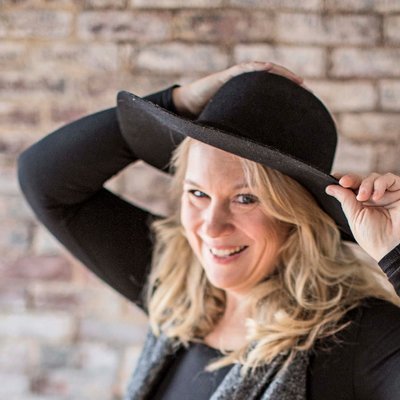
Tina Dietz is an award-winning and internationally acclaimed speaker, audiobook publisher, podcast producer, influence and vocal leadership expert who has been featured on media outlets including ABC, Inc.com, Huffington Post, and Forbes. Tina’s podcast, The StartSomething Show, was named by INC magazine as one of the top 35 podcasts for entrepreneurs. Tina’s company, Twin Flames Studios, amplifies the influence of leaders, experts, and companies around the globe.Tina joins Mitch on the podcast to discuss the world of sound recording including audio books and podcasting. If you are looking to start your own podcast or want to improve one you already produce, be sure to reach out to Tina! Here’s a link to a free gift just for listening: http://www.launchyouraudiobook.com
To follow Mitch and the podcast, go to https://linktr.ee/beinhakerlaw. The Accidental Entrepreneur is a trademark of Mitchell C. Beinhaker. Copyright 2018-2020. All rights reserved.
Here are five steps you, as a content generator, can take to find your book inside your blog (and inside your other content, too.)
“We all have a book inside us,” as Dana Micheli, fellow ghostwriter points out. I agree with her, but I also believe that content generators, who are practically manifesting material in their sleep, already have a book outside of them. They just don’t know it…yet.
I consider a content generator a business owner or entrepreneur with an abundant blog, LinkedIn articles for days, keynote addresses and speeches filling up digital file folders, transcripts of every interview they’ve ever done (podcast or otherwise), and copies of any free eBook, presentation, or article they’ve ever written. Whether they’ve generated all this content themselves, or benefited from the support and talent from content writers, copywriters, and/or ghostwriters, the fact is this: They are sitting on a content gold mine, each piece a precious gem, and part of a book just waiting to be produced.
I’m fortunate to work with clients who believe in the power of content and who leverage me to help grow and nurture their mines. Most of them want to produce their first book (or next) but struggle with repurposing their content or searching for the parts and pieces to produce a book—a book that is focused, well-written, showcases their expertise, offers value to their audience, and boosts their business credibility and brand.
Here are five steps a content generator can take to find a book inside their blog (and any of their other content, too).
STEP 1: Identify Topical or Thematic Threads and Trends
List all the places where content exists and visit these locations. Review headings (and subheadings) and scan your content. Note keywords and other recurring ideas that you notice.
Rank your discovered themes/topics and choose the one that speaks to you the most, or aligns with your brand and vision for your business. By going through this process, you’ve found the focus of your book. (You’ll also likely find the most precious gems: the stuff you once wrote that really shined above the rest. Hopefully, those pieces make it into your final work.)
STEP 2: Define Your Reader and Relevance
Now that you’ve identified your topic, pull together copies of each piece of related content. Scan the content and ask yourself: who is my ideal audience? Why is this topic relevant to them? What will they get in reading this information? How is it different and new from what already exists? To take this one step further, envision all this content in its final version (a beautiful book with your name on it) and reflect on what your intended goals / hopes / outcomes are for this book.
STEP 3: Outline Your Table of Contents
Determine where you believe you want your reader to begin and to end. Mark the beginning as A on a piece of paper, and write B on the other side. You’ll fill in the outline of A to B as you read your content again, and this will become your table of contents. Now, this time, you’re not going to just look at content online. Print everything relevant to your topic. Read each piece then set it aside (temporarily). Yes, this may take you some time. You’re mining for the gold here. What are the relevant pieces that really stand out? How do you see these pieces creating an arc of the work? Organize your content based on how to get the reader from point A to B. List the titles of each individual piece in your outline according to how you think they should be ordered.
STEP 4: Investigate Gaps and Goodness
Pinpoint what’s missing and what’s already kicking butt. Read your content from start to finish in the order you outlined. Record what is working (‘goodness’) about what isn’t (‘gaps’). Make a plan for addressing the gaps. This may mean reading it out loud to yourself, taking some time away from the draft, running it through spell check, asking a friend to proofread, etc.
STEP 5: Polish Before Your Publish
Polish your work so it’s crystal clear and shines like a diamond. It’s time to fine-tune things before you publish—no matter what publication route you go. When you’ve finished addressing the gaps, read the full manuscript for clarity, cohesion, and flow. Mark the text where adjustments need to be made. Proofread with an eye for spelling, grammar, punctuation, etc., and review for formatting and styling consistency. Solicit the feedback of others you trust to give you a professional and critical eye, and assess if you achieved your goals.
You have now finished mining a book out of your voluminous mountain of content.
If you need some extra support with these five steps, you can snatch up my free gift, Finding Your Book Inside Your Blog: A Content Master’s Scavenger Hunt & Field Guide to Find the Pieces to Produce Your Book.
Alyssa Berthiaume is a native Vermonter, professional (and creative) writer, practicing feminist, recovering middle child, wannabe superhero, and a mom who’s pretty sure she’s “winging it” most of the time. She’s the leading Lady (Boss) and ghostwriter at The Write Place, Right Time – her virtual boutique of writing services for badass coaches, trainers, and speakers, and other badass entrepreneurs who don’t “do words” but know they need them. To know more about how she can “do words” for you, visit her website.
Alyssa Berthiaume– Copywriting, Ghostwriting, Lady Boss and Owner of The Write Place, Right Time
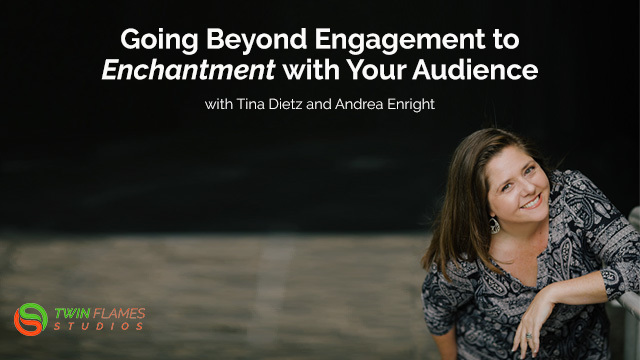
Tina Dietz talks to Andrea Enright about the importance of not just engaging, but enchanting, your audience.(Facebook Live, August 11, 2020)
Tina Dietz talks to Andrea Enright about the importance of not just engaging, but enchanting, your audience. They discuss:
How “engagement” has become a social media buzzword
How it’s vital to make people understand what you provide, not just what you do
The importance of being authentic
Tips for improving your profile and presence on LinkedIn
The value of stories for creating enchantment—but avoiding the “Once upon a time” trope!
Listen below:
Hey everybody!
Since I’m posting this publicly, I’ll introduce myself really quickly. And then of course, my beautiful friend and colleague here.
So those of you don’t know me, I’m Tina Dietz, I’m the owner and CEO of Twin Flames Studios. I have been building businesses for many decades internationally, but what me and my company do best is unleash the voices of trusted brands and companies, executives, and leaders worldwide. We do that primarily through audiobooks, podcasting, and vocal leadership.
I’ve decided to go ahead and talk with some of my colleagues live—we have all these conversations that happen in the background, I know all these amazing human beings who are out doing incredible work in the world and I thought, “Well, you know what, why not share some of this awesome with the world?”
This is Andrea Enright from The Boot Factor—and I’ll tell you more about her in just a second—but Andrea and I had gotten to talking about the proliferation, the outrageous number of people claiming to be LinkedIn experts that is happening lately. And all the mistakes that people make in their branding and their messaging, and how tired we are of certain conversations in the industries that we work in with consulting and coaching and service industry professionals.
We work a lot with the financial industries, and with high end consultants, with healthcare organizations—pharmaceutical—and training organizations. So you know, we have all these inside conversations; now we’re bringing it back out to you and today what we’re talking about primarily is the conversation around engagement: “Well you have to create an engagement on social media!”
Are you tired of that? I’m tired of this.
Buzzword, buzzword, buzzword!
It’s such a buzzword right?
Let me tell you more about Andrea before we get into this. So Andrea, has been an entrepreneur since 2002. And much like myself, she has a checkered past…
Well, they’s fun questions to come. That’s what we call a hook!
Love it!
But she’s been working, beautifully, with coaches, with consultants, a lot of folks coming out of the corporate world becoming consultants, and helping them to clarify their message—”Please god, clarify your message”—and get your message out there, in these badass elevator pitches, making sure that your LinkedIn profile is, I’m gonna use a really horrible term, “on fleek.”
But making sure that it is beautiful and pristine and represents exactly who you are. We’ll talk a little bit more about how that gets done. Because that is an art and a science. And she’s just a really cool person to hang out with. I love her because she’s no BS. That’s what we’re mostly talking about here.
So, thank you for joining me here today. We were having some technical issues with Facebook Live, so thanks for hanging with me through that.
Thanks, Tina!
Yeah. Sorry, do you want me to—should I talk about—
No! Talk. Absolutely! Go ahead. I’d love to have you go and dive in. I’m curious, what did I miss?
I mean… I really work with coaches and executives, and really helping people get brave with their brand, basically. When you get brave, then you get to something called, what I’m starting to call, “Leads In,” which is getting Lead Gen without freaking out, you know?
Yes!
Without the panic! So, if you can get to your authentic self, and you can get brave, and you can show up and get vulnerable and show just a little bit of lack of perfection because nobody wants to see that—we’re totally bored with it. We’re not interested in a long list of achievements.
And I think… Here, how about this? This is really what it sums up—most LinkedIn profiles start out with, like, “I’m not sure how to tell you this, but I’m kind of a big deal.” Right?
Yeah, actually, mine does. I know mine’s up for an evaluation. That’s one of the reasons you and I have been talking And I haven’t updated it yet. Because I’m intending to have your badassery all over it! So, that was the way it got done.
And it’s the same way with webinars and things like that, you know? Speaking from my own experience: I’ve had to talk to a number of clients in the vocal leadership side of things to please, please, please tell a human story. Don’t spend twenty minutes talking about your long list of how perfect your life is before you actually teach anything or share anything or give people any value about why they’re there.
Right! To give people credit—to not totally throw everyone under the bus—LinkedIn was set up originally as like this resume place, right? Like this job seeking place. So people are like, “Oh my gosh, I better put everything that’s amazing about me in a long boring list, like a play-by-play timeline of your life.” And guess what? Nobody cares!
Yep.
Just please summarize for me, because I’m not getting past the third line.
Yeah, and that’s it. Our attention spans are like that of a gnat, pretty much, online these days. And, well, here’s what here’s one of my other favorites: I’m sorry, guys. We’re not trying to totally throw you on the bus here. If you have any of these things, it’s okay. We’re all human. It’s a good time. But you know, how about how about this? This pose!
It’s true! I think people get really self conscious about “How am I supposed to look?” It can be okay. If you’re looking authentic, if your teeth are showing, if you’re smiling, if your face is taking 60% of the frame.
Yes—please.
Then you’re good. I don’t care what you’re doing. But yeah, there is a pose—a perfection about it. And people are just not interested in that. And now LinkedIn is going from like resume to resource, like, “How can you be of value?”
Yes! From resume to resource! Let’s talk about that. We’ve been doing some different things on LinkedIn this year and really doubling down on using LinkedIn.
We’ve been using LinkedIn a lot in the background and now it’s kind of having a resurgence. I think for a long time, LinkedIn was a bit of the redheaded stepchild of the social media world, and now it’s having a resurgence because so many more companies—we’re business to business companies, and us marketing high-end services on Facebook does not work. Same with Twitter. Forget it.
Yes!
It’s noise. It’s just noise. So we’ve been having a lot of a tremendous engagement—hopefully enchantment, we shall see—with folks. And getting tremendous reach on our post, sometimes up to 65, 70,000 people seeing our posts! But it takes a lot of time to craft these messages, and get things out there. Fortunately, I have a fabulous team and they’re really helping to repurpose content, get things out there every day on a regular basis.
But you know, where do you think people should start? Do you start with the content? Do you start with your profile? Chicken/egg.
I want to talk about the posting because I think there’s a big shift that needs to happen with the posting. But the profile is really where you start. That’s where you should start with anything. If you are a high-end coach, executive turn consultant, speaker, author—people are googling you, they’re finding you, please start with your profile, and turn that into a resource instead of a resume.
So, how can you give a soft sell and create Thought Leadership, and give them something that they can use in their meeting today at 3 o’clock—and this is amazing! This makes them think, “Oh, wow! She knows what she’s talking about,” and “Oh, wow! I’m going to call her anyway.” They’re not going to go implement your shit with this “three tips” that you give them. If they’re serious, they’re gonna call you. So this is really just—it’s giving. It’s giving stuff away and being okay with that. It’s serving instead of selling.
Serving instead of selling. That really is the key, and I think that it’s also important if that feels like a foreign concept for people. Because every so often, most of the people that we work with are heavily service-oriented, heavily relationship-oriented. They’re used to doing a lot of business what we would call “belly-to-belly.” But I think a lot of folks have a difficulty translating that to online, particularly our podcasting clients.
We work with a lot of folks who are very high touch, very white glove, wealth managers and consultants, who really spend a lot of time cultivating relationships with their clients. So when you go into a social media situation, it feels sometimes to them—not only like the Wild West, but like a foreign entity, like a different language they have to speak.
We talk about being vulnerable. We talk about being authentic. But for somebody who’s having these long conversations with people, how does that translate?
This has been a perfect segway because of Zoom, because of having to switch to Zoom. So, people are like “I meet my clients face to face, I can’t give them this custom thing. How do I do this?” And really, I think it used to be building a LinkedIn profile to get people to know, like, and trust you—
Yes, classic.
—and that was, like Dale Carnegie. It’s like, Okay, “How can I get get those people in,” right? But now it has to be these three things, I believe, these three pillars. Mine are: Translate, Educate, and Enchant.
So, we Translate that message; and the biggest way we do that is, because we’re not face to face with them and we can’t see, we can’t go off their cues—we are not in real time—we have to Translate that message, and we have to think, “How can I think of it in terms of how they’re thinking about it.” Not “how I’m thinking about selling it,” because nobody wants to be sold to. “How can I think about it in terms of them receiving it?”
What is their pain? What’s keeping them up at night? What is the wound that they have that they can that they cannot get past? What is hurting? And what will then make them think of that message in a translated way. So, Translate is really that first one.
Yeah, Translate very, very important there.
And here’s the other thing. You mentioned something we talk about a lot in marketing, on the marketing side of things, which is pain points. I, personally, am pretty uncomfortable with the terminology of that, and a lot of my clients are as well. So, I want to translate that piece as well. Because classically, we do talk about pain points and identifying their pain or their wounds, and things like that. I want to counteroffer something here and say, you know, it might not be something that keeps people up at night, but what’s the itch they can’t seem to scratch? Or what do they have questions about? What are they curious about?
It really is all about putting yourself in the other person’s shoes. My clients are doing well. They’re doing well for themselves. They’re really out there helping other people. But if I were to talk with them and say, “You have to have a podcast or everything’s going to hell,” that’s never going to happen.
Okay, that is a great point, and I think pain points can matter. Two things come to mind. One is that I recently redefined for me the definition of… redefined “brave,” because “brave” used to be like, being scared and doing it anyway. Guess what? That’s really not good advice for a teenager who’s just about to enter—
Yeah, it’s a little bit psychopathic on occasion.
Right! Like “Oh, you’re afraid, but keep going!” So instead, I think it’s this inner knowing or this inner voice, and I think a lot of my clients’ pain—it hurts not that bad, but they know that something’s off. They know they haven’t tended to something, they know there’s a voice that’s—that they’re hearing these whispers. So, I think when you have that inner knowing, that also moves you into that brave position, and into that position where you’re like, “Look, I’ve got a change, I’ve got to change something. I have to go that extra step.”
That makes total sense. I had a really important turning point in my life a couple of years ago, where I realized that I had this background mantra of “I’m fine; it’ll be fine. I’m fine; it’ll be fine.” That’s a really good thing if you’re just looking to evaluate something and truly let it go, but I realized that I had spent a lot of my life talking myself into things being fine when they weren’t fine.
Right. Right.
And so, I think it’s important, if you are listening to this right now, if you’re watching this right now, and you hear yourself trying to talk yourself into something that “It’ll be fine. It’ll work out.” That is a red flag.
It’s a great point, and I think that leads me to this “fear abundance.” When I’m talking to people, when I’m helping them establish their brand, and they’re wanting to sell—I’m like “I’m not going to outlaw it, but let’s try not to wrangle our clients, or potential clients, into a position of fear.” Like, “Oh, my God, if we don’t do this, things are going to be over.”
Yes.
You don’t want to instill that kind of fear. I really want to get them out of the trance of scarcity and toward a mindset of abundance, right? There is more; there can be more. You can find more. And so, I think that’s important as well.
Yeah, I couldn’t agree more.
So what are some of the other things that you tend to see—and we’ll stick with LinkedIn for right now because it’s a good focal point for us to look at—especially if we’re considering that how you do one thing is how you do everything. It is a place where we’re focusing on showcasing ourselves as well as our businesses: Who are you, as an individual, as a leader, as a CEO, as a consultant.
But truly, we’re not looking at business pages, or company pages, the same way we tend to look at individual profiles. So what are you seeing that people are missing the mark on this?
A couple things. One is they’re thinking of themselves very firmly attached to the job that they currently have. When you do that, and then that job ends, and then your life will shift. So what we have to do on LinkedIn—and with a personal brand—is really talk about yourself, and brand yourself, in a way that is connected but independent of your job, right? So then when you’re moving on, when you’re moving up, when you’re moving over, those skills are much more easily translated.
I see people describing what they do in their job instead of what they do around their job, and for the company. So it’s task oriented instead of outcome oriented. I think I’m definitely seeing that as a mistake.
That’s a really important focal point, and I want to build onto what you’re saying. On the podcasting side of things, we often work with folks who are emerging—in their thought leadership, in their vocal leadership, in their messaging—and we see the same thing: I have a client right now, actually, who is still so firmly ensconced in the corporate world, does a great job there, has been there for 15 years, but he has a whole other company that he’s been developing on the side.
So, the dance he has to dance is in speaking broadly about who he is, what he stands for, what his values are, and—rather than a lot of how to, or any kind of pitching or things like that—and that’s a that’s a real mindset shift.
It really is. I’ve seen people do that though—you really can go from, “Well, what am I really bringing to the table on the board position I have, in my company, in my side business? Why am I valued?” Then going from there, we see that people are putting their positions. They’re just treating it as a resume. Instead of a headline at the top, I see a position. It really, in my opinion, should be a headline. It should be who you help, what you actually give. Not advice; you give peace of mind. Not a massage; you give out relaxation.
Translate what you do into what people are really getting, and try to lead with that. Positions mean less than they ever have, because they hand out positions because they can’t pay you more sometimes. Isn’t that true? I mean, your executive title does matter, but that doesn’t really tell me how you’re any different from the other VP. So you can have your position, but then I want to know more. I want to really know the hard skill and the soft skill of what you’re bringing to the table.
And I want to give a shout out. A lot of what I’ve learned is from my LinkedIn coach Ellen McLemore. She’s amazing. She really has helped shift my mindset on LinkedIn, and that’s been that’s been huge. It is really a mindset shift.
You know, one of the things that just occurred to me is the concept of elevator pitches. Which is something you work a lot with as well?
Yeah!
How does that interact with something like LinkedIn, or does it at all?
I think it really does. You have to remember that it’s all about context, so when I’m sitting next to someone on a plane (in my non-COVID life), I need to have an elevator pitch that is a hook, and it’s just enough for someone to turn their head and say, “Tell me more.” Or if I’m on a networking event, or if I’m a Zoom call.
But on a LinkedIn page, it’s much different. We’ve got the scroll, we’ve got someone clicking, we’ve got someone distracted by their other tabs, and so we have to go in these little bits—and they’re going to scan them. I do think the elevator pitch absolutely should be woven into the LinkedIn profile, but I would try to squeeze in some of those words I usually use into your headline. That’s where I put them first, because that once you get into your “About” section it’s a much different formula.
Yeah, I think that makes a lot of sense. So then coming back to our original topic of this idea of going from Engagement to Enchantment, what do you think are the differences between the two? We’ve seen a lot of engagement on things, but whether somebody leaves “enchanted” or not—
Yeah!
—Customers or clients certainly do, but what about interactions out in the world on a daily basis?
There’s a few things we can do, to do this. Engagement is like, “Hey, I’m paying attention,” which is what we want everyone to do. To me it’s like a bare minimum of having a conversation. “Is someone paying attention to me? Okay, I’ll keep talking,” which to be honest, I’m not super comfortable doing. If they’re just gonna stand there, and keep talking just because, okay, I got their attention—I want more, and so it’s just not enough.
To really create what I call “Enchantment,” we are going to take them by the hand and lead them on a journey. We are going to look them directly in the eye and create an intimate conversation. We are going to make them feel as though we are talking directly to them. We do that by getting human: by using human phrases, by really resonating with not just their head, but also their heart—
Yeah!
—and getting vulnerable. Most people are. Why this is hard, is, it’s scary to be vulnerable—people are a little afraid to put themselves out there, and they’re also very afraid to be specific—to really talk to that one target audience person that you want to reach.
Right! That idea of “Well, if I niche down, I might miss someone or something.” That’s another indication that your mindset may be a little less than abundant, perhaps, and that’s okay. We all do this. Like we hit these walls, we hit these ceilings of everything that we do.I think this is also a really good place to remind people that you don’t constantly have to be telling a deeply intimate personal story—you can just tell a story. This is the storytelling portion of things. It’s not “Once upon a time…” necessarily, but this whole idea of creating intimacy, creating connection, and creating authentic, heart centered, alignment with another human being. That is, we connect with these little stories. We’re all wired for stories.
I would say even that storytelling’s become such a buzzword. The problem is that not everybody’s good at telling a story, and that’s okay. Not everyone’s a storyteller, and so one trick is to remember what you said—it doesn’t have to be vulnerable.For example, in my profile, I used to say something like, “There’s nothing I love more than mining you for your magic and building you a great brand.” And then I say, “Except maybe chips and salsa, but otherwise you’re number one!” It just gets a giggle, right? It’s sharing something about me that’s not vulnerable or secret or anything, I just like chips and salsa!
But it makes me like a human instead of a company, and people just they just respond to that!
Right, exactly. Yeah. as well. Another point in your bio, you say, you know, you speak to audiences—speak and sometimes swear, in front of audiences—I do the same thing. The little bit of human internal conversation with these little moments that create connection and create this sense of “Oh, I know you.”
Right! Like, “Oh, I know you! You’re like my neighbor” or “I know you! You’re like my daughter.” Like there’s a resonance there. I think you really hit it too with this. There is that storytelling, but it doesn’t have to be much—not “I’ve got to tell this long story.”
No, no. I was just working with this absolutely brilliant chiropractor. He’s invented this incredible machine to help people with low back pain. He’s an older gentleman, credentials out the yin-yang, and he’s about to be on his first podcast.
But the question that always gets asked in the beginning of a podcast—notice I didn’t ask it—is, “Tell me a little bit about yourself. Tell me what brought you to this place.” Or “Tell me about your journey?” I hate that question.
It’s a lazy question on the part of the host. Sorry guys, it is, and it is boring to the audience because everyone answers it the same way. They always answer it, “Once upon a time… Well, I lived in a small town, and I grew up, and I got this degree, and I started in this job, and…” Once upon a time stories—we are programmed to go to sleep when we hear “Once upon a time!”
That’s a good point!
So all we did was have him say the main thing that he spent his whole life doing: “What’s the main thing that you spend your time doing? What’s the main thing—the outcome they reach?” He said, “I spent my entire career reducing people’s pain and suffering without drugs or surgery, and it was actually back when I was in high school as a 90-pound weakling on a football team.”
People are like, “What?” It’s a 180 to tell this beautiful little story. Now he’s just a dude, you’re hanging out with coffee, who’s telling you a story. By the end of that very short story I might add—of how he kind of discovered the possibility of chiropractic through high school injury—everyone’s like, “I love you!”
It is true! The thing is you have to be aware enough. A great exercise to get you to this is just asking yourself five or ten questions that I include in my Boot Factor brain questionnaires, like, “What do you think about work? What do you believe about humans?” Just those two, right like, something’s come up, right?
You can journal on that for a month.
Right! They’re like writing prompts. You just have to answer those, rather than “Where was I born?”
“What do you do really well, what’s most important to you?” And I like to ask little silly things like, “What’s on your nightstand? What’s your favorite food? What could you not live without—not your phone!” It gets into people’s habits, so that’s really about digging and trying to show up in just this little way on your profile.
Let’s get some people hooked up here with connecting with us further. So the best place, Andrea, for everyone to reach you is at TheBootFactor.com; is that where we want people to go and check things out?
That’s right! You can go there, sign up with my scheduler—it’s right on the front page. If you go there and mention the Facebook Live, you’ll get a 20-minute, free LinkedIn lowdown session with me. And I’m telling you, we’re gonna have fun!
Oh, I’ve done it with you. It’s very enlightening.
Yeah! I don’t do anything without like having a little bit a little bit of moxie, a little bit of craziness. And you really will get some quick answers that you can check off.
Kickass! So go to The Boot Factor, literally: Go to TheBootFactor.com, schedule a 20-minute LinkedIn conversation—it really is enlightening. I’ve done this with Andrea and she really will kick your ass in the most beautiful and loving way. And you need that—I know you know you need that.And if you want to connect further with me and with Twin Flames Studios go to TwinFlamesStudios.com and check out what we do there. Check out our audio library of podcasts and audiobooks. Also feel free to reach out on our contact page anytime. You can find us all over the social media networks—”the internets,” as it were—under our name, because we have done the work and we show up on Google.So there it is. So hey, Andrea, thanks for joining me from… Denver today?
Yeah, Denver.
Thanks for joining me from the mountains. I am in the flat, flat land of Florida, as we have this cross continental conversation in the time of COVID. Thanks everyone for joining us!
Got questions? Leave a comment and we’ll talk to y’all soon.
Yeah!
Bye!
Interested in learning more about audiobooks and howyou can be using audio inyour writing career ?
How would you know if it’s the right time for you to start publishing a book? Tune in to this Pod to Publish Book and Audiobook Masterclass and find the answers.(Masterclass on Free Your Brand Podcast, July, 2020)
For many reasons, podcasters are uniquely suited to publish books and audiobooks about topics that are of interest to their existing audiences. Not the least among these is that they already have an audience in place—it’s just a matter of channeling them to another medium. Not every podcaster is cut out for this, however. How would you know if it’s the right time for you to start publishing a book? In this masterclass, Tracy Hazzard is joined by Juliet Clark, the Founder of Super Brand Publishing, who gives tips on writing a book as a podcaster; and Tina Dietz, the CEO of Twin Flames Studios, who follows up with some of the basics of audiobook production and publishing. Each an expert in their own spheres, these powerful women are partnering up on a venture that seeks to put creative power back in the hands of creators. Listen in and let them help you amplify your message even further.
—
Watch the episode here:
Listen to the podcast here:
Pod to Publish Book and Audiobook Masterclass for Authors and Podcasters with Juliet Clark And Tina Dietz
I’ve got Tina and Juliet here. Our subject on this episode is Pod to Publish. I want to cover a couple of things first for you. First, why Pod to Publish? Podcasters have a distinct advantage that published authors don’t—speakers and authors have the same problem I’ve come to find over time. We sustain our audience over here. We do week after week. We’re in the ear of our audience and that has a powerful effect. We want to use that to our advantage. That’s the angle of how we’re going to talk about going from Pod to Publish and what you can take from your show to create a wonderful, bestselling book and an audiobook, because there’s a match in our audience there.
When you command your brand and your audience, you get that audience focus and attention week after week. You also see the topics that are of interest, the ones that increase engagement, the ones that are controversial, people are highly interested in and want to learn more about. You can see that because you’re supposed to see that and how your episodes are ranking, but you can also see that in the engagement that they’re getting on social after you air them. If we pair that with our website—we’re driving traffic back to our website—we have a distinct advantage over authors and speakers who don’t own their audience.
When you go out there and speak, you’re speaking in front of somebody else’s audience. They own the audience and very few of them share their audience with you. Very few events give you the email list of everybody who’s there. You have to pull, grab and try and get everyone in that audience to connect with you, but that’s not the case on your own show. Your own show, that audience belongs to you or they wouldn’t be subscribed. You still have to get them off of there and that’s why I talk about the website strategy because if we add in our website strategy, we’ve got a place to capture emails to get people.
We’ve got to get them off of Amazon if we’re already on there as an author. We have a lot more command over that audience connection so we know what to write about. We know what interests people, and we also know how to engage them and get them further through the process. For most of you putting out a book has a business purpose, and that’s what Juliet Clark is going to talk about. Making sure that we write the right book. I’m going to be honest with you: The very first one is completely the wrong book. I followed one of those models, hired one of those companies doing “speak to book.”
It felt all wrong the whole time I was doing it. It felt like totally introspective. It felt like all it was about me. I was like, “Is this what people want to read about? Are they going to be interested in this?” The questions were going through my mind the whole time that we were doing it, the whole time that we were recording this book. Plus, I didn’t love the whole record-to-book process because it felt contrived. It didn’t feel like it flowed, it didn’t feel organic for me. It didn’t feel like it was, “let’s explore these different topics and then assemble it together.” That was my process.
It didn’t work for me—I never published that. That has been sitting on my credenza for years. Of course, I didn’t need it, because I had a show and I was given an Inc. column. I was asked to write an Inc. column almost within 6 or 7 months of having my show. I thought, “I should be an author because I have a column. I should go out there. I’m a writer so there should be a connection between my audience who wants to read something—I should have a book.” Hence book number two, which got as far as getting a cover. It’s pretty edited and it has all of the relevant articles. I was starting to hit onto something that was working for me. It has all of the articles that were highly ranked and trafficked within my Inc. articles. There were lots of great connections and things going on here. The problem is that the longer it took me to do this, because of the way the writing happens? There’d be new articles and I felt like the book was constantly out of date.
Instead, I just started a second show on this and that’s how Product Launch Hazzards come about. That was my fast way of doing that, and also because it didn’t have a good business strategy. That was the number one reason I didn’t launch that book. I could have still launched that book, which would have been a great lead generator for audiences to my show, but I didn’t want to run a business. I wasn’t operating a business model that did anything but want to attract audiences. I didn’t want to sell them anything. I didn’t want to do any services. For us, it was an older business model. We were sharing our information to give it away and make sure people had it. That book didn’t make a lot of sense for me to put money into something that didn’t have a business purpose for me at the end of the day when the articles and all the other things were already out there. If it was my primary goal, this would have been the ideal book to write. It just wasn’t for me in terms of business purposes.
I’m onto my third book. This one is on its way to being published. I already paid Juliet for it—we’re on our way to doing that, and it is going to be our book for podcasters—for new and aspiring podcasters, not for existing ones. That’s going to be a whole other book that will come out and that will be the second book that we’re working on. We’re working on that from my show, The Binge Factor. These are the kinds of things—I’ve done it wrong, but lucky for me, I didn’t spend all the money. I stopped when I realized how hard it was going to be to market or that the business plan wasn’t there because I have a bigger view of the marketing programs. Also, the business plans, the things that we want to do, the flow and the lead generation that goes through my business and what’s happening here. I stopped myself before I spent the money to find out that the book did nothing for me and it wasn’t going to do anything for me.
I had great advisors and two of them are here. That’s where we’re going to lead into having Juliet Clark, who is an expert in profitable book launching. She’s a bestselling author herself. She knows what it takes. She advises authors, speakers, and experts who have a business, who want to promote, profit, and publish—which happens to be your podcast name—their book. They want to profit before they publish. They want to make sure they have a platform. They want to make sure they have an audience. She’s the Founder of Super Brand Publishing. She’s going to cover why you should or shouldn’t be a published author.
Following Juliet is going to be Tina Dietz, who is an audiobooks expert. She has a full-service audiobook recording studio called Twin Flames Studios. She’s going to talk about the audiobook opportunity and the match to us as podcasters. I love this. The thing about Juliet and Tina, and the reason they are both here on our Masterclass, is because like us here, we all believe in retaining your rights and doing the things that have a business return on investment. Returning new leads, returning your business, ultimately returning your profits. That’s why I’ve asked them to do a masterclass with you. First up is going to be Juliet. Let’s go on and have you give us your first segment on authors.
—
Juliet:
I’m going to talk a little bit about authority books, but I’m going to talk about first, why you need to have authority before you write this book. We’re going to be pulling the curtain back on, are books still relevant? For the most part, a lot of us think they aren’t. What are the big book mistakes we’ve seen and why podcasters are great people to put books together, especially audiobooks. It’s about repurposing content with meaning, and having a plan to monetize all of this.
Books do matter. They are still relevant, but only when they’re done right. The one thing that Tina and I talked and laughed about all the time are all the bad books out there and that’s because people have written them for the wrong reasons. They didn’t have a plan, and they didn’t move forward in a way that was profitable for anybody. The first question you need to ask is, “to book or not to book?” This is where I proved to you that I’m the worst salesman on the planet because not everyone should write a book. We don’t take every book that’s brought to us.
There has to be a plan and a reason behind it, and I’m going to talk about some of those things we see that are reasons to not write a book because I want you to identify yourself in this. One of the things that happened for me on my journey to book writing— for those of you who don’t know, I wrote my first book in 2010, it was a mystery novel. I killed my ex-husband in it. I was going through a divorce. It was not only a fun and cathartic experience, but it was also the wakeup call—I had been in traditional publishing—to how bad the self-publishing model was, and how they were ripping people off. Those types of companies will take your book no questions asked, but that’s not always a good thing. Here are some of the things we’ve seen throughout the years of self-publishing.
We’ve seen a lot of life stories and I hate to be the bearer of bad news, but for most of you, your life is not exciting enough to write a life story. You want to leave a legacy book for your family—that’s fantastic—but most of you, it’s just not worthy. Poorly written books—there are a lot of people out there that we have encountered that have not written great books. Not just grammar and all of those types of things, but the way the book is structured, it doesn’t make sense, it ends up being what I call a “barfa book.”
Some of the big mistakes we’ve seen throughout the years are experts who were writing books to make themselves experts. These are people who went to a business “ra-ra,” they indicated that they were online, marketers, their products and services weren’t selling and the guru in the room saw a moneymaking opportunity and said, “You need a book. You need to be the person that wrote a book on this topic.” That book, if you don’t have an author platform built—that meaning an audience—it’s going to be another failed product. We’ve seen a lot of that going on out there, and just writing it doesn’t make you an expert.
Another one we’ve seen a lot of is what I call the Life Story, but it’s people who wanted to talk about their journey, and instead of talking about their journey, they put out a “barfa book.” It wasn’t interesting. It had things in there that were too much information. Especially if you have a business, you don’t want people to know every little thing about you. These didn’t sell either. They were poorly written, and it wasn’t enough substance about the expert, and it was too much about the individual who was writing the book. I always call these “big ego books” too.
The other mistake we saw was: no structure, focus, or professional input. You started writing a book on your own one day and the structure was not where it should be. You didn’t have endorsements. You didn’t have an intro written by somebody who could help you sell the book. We see a lot of that. Probably the biggest mistake I see is someone who comes in with a book and when I ask who edited it, they’ll say, “My Aunt Peggy is an English teacher.” That’s not a professional editor. If you want to bust out in a professional way, your book has to look like a book that a traditional publisher would have taken on. Another big mistake is experts that are in search of an audience. Anytime you have a product, service, or book where you wrote it without feedback from your audience, you’re going to fail with that product. That’s what’s happened with a lot of these experts that are in search of an audience. You need to have that audience first.
I know all of you are podcasters—you’ve already done that. That’s what makes you an excellent prospect for this, because you have a built-in audience. Another big mistake is people who write books too soon. If your business is brand new or you haven’t monetized yet, it’s too soon to write a book. That’s the perfect kind of book that we like to send on its way.
Back in 2015, I had a woman who came to us, who wrote a book. She worked with our writing coach on a “six figures to six months” book. When she got to chapter eight, which was Joint Ventures, she just got stuck. The writing coach came to me and said, “I don’t understand why she stopped.” I picked up the phone and called her and said, “What’s going on with this chapter? I met you at a joint venture event.” She admitted that she had never actually done joint ventures. She was writing this book without tried and true products and services that she had tried herself and been successful with. If you’re not successful with what you’re monetizing yet, it’s too soon to write a book.
The result of all this is that most independent authors will sell less than 100 copies of their book. You’re not going to get the ROI you’re looking for at all. The other result of this has been a lot of publishing on Amazon and if you only knew what the backside of Amazon provided you, you wouldn’t spend the $200 to do it. Amazon does not have true publishing services that are legitimate in the worldwide distribution or worldwide royalty capture. There’s a lot going on back there that because you don’t know what you’re doing as a first time or second-time author, you don’t understand what you’re getting into. The result is also what I like to call The Invisible Author. You write the book, you get it out there and guess what? People still don’t know who you are because you didn’t build that audience in advance. Why is this such a great platform for podcasters? First of all, you’re experts. You have episodes out there. You’re talking about what you do. Most of you have this monetized in some way. Your show is not your only monetization point. You have multiple streams of income through your company you are in a perfect position to drive traffic from your podcast into the book, and into other products and services.
Also, because you’re bingeable. It’s easy to take a thematic group of episodes and make them into a book that’ll be bingeable. Sometimes people don’t have the time to listen to every single podcast on a particular topic, but you can group a topic together and make it into a how-to guide. You can make it into an informational piece about, to give you an example, Seven Ways To Capture Expert And Expert Audience. You can put this all together in a thematic book that is helpful. Because you have the audience you need, you’ve already built what I would call an author platform through your expert podcasting. This also is because you have content. If you’re like me, I’m about to hit my 100th episode. I have more content than I ever envisioned I would have in my life. I can write a ton of books and be happy about it. You also have the credibility at this point. People already are listening. They understand that you are the go-to person in the area that they’re looking for help in. Also, you can create, easily, a thematic help book.
Another thing that a lot of people don’t think about is the learning styles. There are three different kinds of learning styles out there. The visual, auditory, and kinesthetic. With your podcast, you have the auditory covered and for most of you, if you’re using the Hazzards, you have your YouTube channel, you have the video. There are people who learn and enjoy content kinesthetically. The book provides that for people. They like to hold the book in their hands. I hear all the time that many people don’t look at it. They don’t use Kindle because they liked the feel of the pages and the book and Tracy’s one of those. She tells me that all the time because I tell her to do more Kindle and audio. You can reach a little bit different audience with that actual physical book.
This also adds to your brand. You’re bringing brand awareness. You’re expanding the awareness of your brand, not only from the show, but a lot of times we will use the free book funnels in conjunction with our book products. That brings you into a place where you can communicate with your actual audience that wants that book. You can send out the free book, you can upgrade them or have them pay for an additional product or service to get to know you a little bit better. If you have big programs like I do, sometimes people don’t know you, like you and trust you enough to take that big bite right off the bat. You’re able to give them small pieces that build trust. Also, clarity about what you teach. I know when we have 100 episodes or I know some of you out there I’m seeing some people that are on here, some of you have 500, 600 episodes.
Narrowing that down into those thematic books about what you teach, and driving your audience into a thematic workshop—also, why books? Books are a low-barrier product to get into your funnels. When you go out and you have a $20 book, that’s a low barrier product that people can hold in their hand and they can understand who you are and what you do. It doesn’t cost $3,000, $4,000, $5,000 to buy a book and find out more about you. The free shipping book funnels that lead into workshops, that lead into those bigger products you sell. This is the way to do it and have a direct connection with your audience. You not only have their email address, but they’ve been willing to pull out a credit card and buy something. That’s always a good sign.
I’m going to segue into what Tina’s doing here. Why audiobooks? Audiobooks have become the top way that people consume books. We are in a busy world. I know myself, I use audiobooks when I’m out running and I’m an avid runner. I consume easily 10 to 15 hours of audiobooks every week, car time as well. Audiobooks are becoming the new way to consume books.
People are used to hearing your voice already, but of course, you need that book to get to the audiobook. They’re more professional. One of the things that happen when you are with a traditional publisher is many of them will automatically sign into an audiobook contract. There are pros and cons with that. One of the cons is that they can choose the talent. When you write a book and you self-publish it and then go on to produce an audiobook, it’s in your own voice that your audience is already used to hearing. When you’re on Audible, people don’t think of you as a self-published author because you’ve taken that extra step to go into a prestige product like the traditional publishers would. Okay! Tina, I’m going to let you go.
Tina:
Let’s dive in a little bit deeper to the audiobook experience. As Tracy mentioned, I’m the CEO of Twin Flame Studios but I’ve been building businesses internationally much longer than I’ve been in the audio world. An opportunity like this excites me to see the different worlds coming together in this entrepreneurial milange that is super exciting. I got into audiobooks and I became a podcaster because books and podcasting are low hanging fruit for people to start to change their lives. That’s what gets me up in the morning and had me deciding to expand my company out in the directions that it did. It’s specifically talking about audiobooks.
The audiobook opportunity is threefold. It is imagination, it is intimacy and it is income. I’d be willing to bet if I turn this back over to Tracy, she would agree with me that podcasting is also very much those three things, and that’s one of the things we have to delve into. How do podcasting and audiobooks fit together as an opportunity while you as podcasters have a much better advantage than somebody starting from scratch?
Let’s do a little history lesson first. There has been an audiobook renaissance. Audiobooks have been around since about 1930. They were produced during the depression on albums and records. I believe the very first audiobook was a series of Christmas stories. They’re a familiar format for people and that is one of the major reasons why they are incredibly popular. If you’re like me, and you remember growing up with audiobooks—maybe you had an album when you were a kid where it was when Tinkerbell rings her little bell, it’s time to turn the page, or maybe you had books on tape. I remember my first one was Deepak Chopra’s Magical Mind, Magical Body and there were fifteen cassette tapes that you had to manage. Later on, there were 5 or 6 CDs that you had to manage. They were always freaking expensive. When audiobooks went digital and in particular, when Audible and Amazon became under the same umbrella, there was a massive explosion.
Back in the day when we first started having the iPod and we could have a thousand songs in your pocket, which was the slogan, then you could have a thousand books in your pocket with the Kindle and now you can have a thousand audiobooks in your pocket with apps like Audible. We have this library that we carry around with us that feeds and nurtures who we are, and we get to be a part of that, feeding and nurturing other people.
What happened in conjunction with audiobooks going digital was that it lowered the production cost. No more jewel cases, no more pressing of tapes or CDs, none of that. With the advent of home studios, that lowered the cost of production even more. Unlike most things on the planet, in the last ten years the cost of producing audiobooks has dropped about 50%. Therefore, it makes it much more accessible for people on the retail side of things to consume audiobooks. It used to be $30 to $50 to buy an audiobook. Now it’s pretty much a flat $12 to $18 to get an audiobook, depending on the length of the book. Sometimes it’s longer.
But it’s available now to everybody. You don’t have to go to a store. You don’t have to have a lot of money to buy and the reach is much bigger. As a result, audiobooks are a $4 billion industry. Year-on-year for the last six years, the audiobook industry has experienced double-digit growth every single year, sometimes as high as up into the 20%, 25%. In one year, it hit 30% growth. Those numbers are outrageous when you think about how businesses tend to grow, 3% to 5% growth for a large industry is more average, not 15% to 25%. However, there is and has been for many years, an issue with the industry. Juliet mentioned the issues with the self-publishing industry. I would say even we take it a step further and say the publishing industry, in general, is a broken model. Taking your rights, taking your royalties for traditional publishing, the predatory practices, self-publishing houses, or experts—all of these things, you have to think about, what is your goal? What’s going to benefit you the most?
Years ago, when I was looking into audio, it was because I’d been building businesses for decades and I’d worked with more than twenty different industries, 9, 10 different countries and at the time I was doing some paid hobby. I’m an entrepreneur. We can’t have a hobby. We have to monetize our hobbies. That’s what we do, and I was voice acting. I was taking some masterclasses by one of the premier audiobook trainers in the world because I was thinking, “It’s a side hustle. This might be cool.” Pat Fraley, who is still teaching and an amazing man, introduced me and the other people in my course, not only to the narration side of audiobooks but to the industry. That all of a sudden created what I call my chocolate and peanut butter moment, which was, “Why aren’t all of the authors I know, all my clients, all of my colleagues, who are doing bestseller campaigns, why not with audiobooks?” That curiosity led me to discover that nobody knew that audiobooks were even an issue and that the audiobook industry was broken. I secret shopped 30 different audiobook publishers, and all of them did the same thing: They took away your control creatively, they made you pay for it, and they controlled your files and your intellectual property at the end. Being a creator myself, I got incredibly offended and said, “We can do this better.” That’s why we started doing what we were doing to make sure that we are advocates for our authors to have a high-quality product, to get out there and do what we need to do to reach a bigger audience.
That brings me to the connection between podcasts and audiobooks. How Tracy and I met was actually, we were both shared some similar podcasting stages. She has Podfest and some other ones; I speak to a podcast audience as well and I’m a podcaster myself. I love the medium and I love the pairing of podcasts and audiobooks together—because you’re already recording. You already have an audio setup. You already clearly, at least in some form or fashion, can handle the sound of your own voice—which a lot of people can’t—and you are in a situation where you’re producing regular content as Tracy and Juliet mentioned. Now what? There’s the opportunity to get out there and create upon your creation.
You create the book from your podcast and then you create the audiobook from your book and this is what we call media matching from marketing. People who listen to podcast are more likely to be audiobook listeners because they’re already audio learners. They already have a leaning in that direction. They like audio and it becomes very fluid and interesting to be able to medium match and be able to market your audiobook, which we’re going to talk about on your show. Market your podcast through your audiobook and use both your audiobook and your podcast as assets to gain you more loyal followers, more leads, get your voice out to a bigger audience. When we create an audiobook, the other beautiful thing about it is that all of your formats on Amazon, in particular, show up on the same page. When you go to Amazon and you go to your book page, you can see the Kindle version, the paperback, the hardcover, and the audio version and this creates what I like to call “might-as-well-itis.”
A lot of times what we find is that people will download the Kindle, particularly if you’re running a free Kindle campaign or a 99¢ campaign. They’ll see the audiobook version and they’ll say, “I have Audible credits. I want to download that book as my first book on Audible.” Why not? Might as well. They get both versions of the book. Your audiobook is never going to hurt your sales on your other versions of your book. It’s always going to be on top of it. Particularly with nonfiction books, what we find is that folks want to have either a Kindle version or a hard copy to make notes. To get the book done, to read it all the way through, they listen to the audio because audio, as podcasters is the most portable, easy to access form of media. That’s why we do it. We can reach more people. Dovetailing your audiobook marketing with podcasting, and this gets very exciting. When you create an audiobook, you create what’s called a Five-Minute Retail Sample. That five-minute retail sample is a little a taster of your audiobook. You can use up to fifteen minutes of your audiobook in your marketing. Fifteen minutes of audio is a pretty long chunk of time. Guess how many different ways you can slice and dice that audio? You can turn it into a video book trailer. You can turn it into audiograms, and you may already be using audiograms as a podcaster.
They’re those little video snippets that you can share on social media that are closed captioned. Maybe they have a little sound wave on them. It entices people who are on the video side of things who are just looking for a little snippet of information, “Maybe I need to go listen to more of that.” You can pair the marketing you’re already hopefully doing with your podcast, with your audiobook, to share on social media. Audiobooks also come with two lovely features when you publish them, and these are bounties and gift codes. When you publish through Audible’s self-publishing platform called ACX, you will get 100 gift codes. They give them to you in batches of about 20, 25 at a time. You can use those to promote your audiobook. You can use them as giveaways. You can print them onto a postcard and sell them as upgrades to your physical book if you’re in a live event.
You can also use them to give to trusted colleagues and friends, or clients to give yourself—as review copies. You don’t get galley copies of your audiobook necessarily, but you can give away gift codes for your audiobook that will allow people to leave you reviews on Audible. Because unlike on Amazon, in order to leave a review for Audible, you have to have that specific audiobook in your audiobook library. If you want to gain additional reviews—which of course reviews are always great—you can use the gift codes to help you do that, and you get a hundred of those. It’s a lot to work with.
The other program that Audible has is called the Bounty Program. This is a bonus for you finding Audible a new customer. How this works is that you get special URLs for the US, the UK, France, and Germany. You use those URLs to share your audiobook. Post them in your newsletters, send it out in emails, use it in social media. If that person downloads your book as the first book that they do on Audible, they’re a new audible customer.
They’ll get your audiobook for free. However, if they stay an audiobook customer with Audible for two months, then Audible rewards you for your sacrifice on your royalties by giving you $75 for finding them a new customer and that, of course, is way more than you’d get on the royalty of a book. I know authors who push those bounty codes on the chance that people are not yet an Audible customer because they’re out there even though it’s a popular format. That is a little bit about bounties, gift codes and audiobook marketing in general and how that’s going to dovetail with your podcast.
What do we do at Twin Flames? We are advocates for our authors. We want to make this easy for you, because the definition of an entrepreneur or somebody who podcasts for business, is somebody who won’t work 40 hours for somebody else, but you’ll work 80 hours a week for yourself. I know that—I’m the same way. What we all need are people who are going to take good care of us, the way we want to take care of other people. That’s why I’m partnering with Tracy and Juliet because we are all likeminded in how we work with the people that we make a difference with. We are here to care and advocate for people and create quality so that your message can get out into the world in a way that’s powerful in multiple ways. We need to be reaching more people to make this world a better place and make a great living doing it at the same time. It’s doing well, and doing good.
We don’t take your royalties and rights. You retain creative control and we make sure that your audiobook is both a marketing asset and an income stream for you. It needs to be both of these things, and much like Juliet mentioned before, we don’t take all the books that come to us. Some of them simply aren’t going to work. We also don’t let everybody narrate their own book because narrating an audiobook is not the same thing as recording a podcast. I will say that there is a 95% chance that because you’re an experienced podcaster and you’ve got some audio setup already going in, and you already have been working with your voice, you will be able to narrate your own audiobook, but we will let you know if it’s not feasible for you to do that and work another way through it.
A lot of our authors do narrate their own audiobooks, but a number of them don’t and they opt for other reasons to have a professional narrator do their audiobook. If you’re curious about that, please reach out and I’ll explain to you the process and the difference. For most podcasters, narrating your own audiobook isn’t an option. It is different than recording your podcast. I would never narrate an audiobook speaking this quickly. I would never use the type of breathing that I’m using and I certainly wouldn’t have my audio set up this way. It is a different animal and it is a different form and feel. This is why we do it the way we do it. We offer our author narrators the option of not having to go into a studio, not having to learn any technology or equipment. What we do is we have professional audiobook directors who are narrators and sound engineers themselves and we remote into your audio setup.
We make sure that your audio is perfect for audiobooks and then we live-direct and record you doing your book. You don’t have to hit a button except to get on the recording. You don’t have to worry about editing, stopping, or starting. You don’t have to worry about, do you sound okay? Are you breathing? Are you making any mistakes? We fully live direct you and record through the entire process, and if any of you out there are familiar with any kind of voice acting—we do what’s called punch and roll recording, which is the industry standard for recording an audiobook. This ensures that your audiobook does not sound like somebody who just sat down and read their book into a microphone. It’s going to be high quality audio. It’s going to be performance quality, and then we can make sure that it’s edited, proofed, mastered—perfect—before anything goes to publishing and distribution.
There are a tremendous number of technical details that go into an audiobook that you’ve got a lot more wiggle room with podcasting than you do with audiobooks. You get to tick off all of those particular details. If you want your audiobook to pass the quality control process to get onto Audible or other platforms. We make sure that all of that gets handled for you and you have all the information you need to maximize your audiobook experience and your audiobook as a process—as an asset—for everything that you do. I am super excited about this entire program that we’re all doing together. I’m going to bring Tracy back in and she can share with you and we can all talk together and make sure that we have enough time to go through our Q&A together.
—
Thanks much, Tina and Juliet. I appreciate you guys coming and sharing with us. What I want to do is just wrap up with a little thought on how you might structure this. Now that you’re thinking, “This audiobook thing sounds pretty cool. I could write the right book. I have some ideas. I’m getting some traction with my podcast already. I’ve got some great guest interviews, great people who would be associated with my book if I had stories about them.” As you’re starting to think about that, what does that book look like? What does that audiobook sound like? As you’re starting to think about this, I’ve got a couple of strategies I’m going to throw out to you, just for you to think about and see if this might be something that would interest you.
Let’s say you have a show that has a lot of guest interviews. It’s similar to the model I did with my Inc. articles. I was writing out great brands, great companies, great entrepreneurs and I’ve got all that going. I do the same thing on my show. If I’ve got a lot of great guest interviews—or that’s the only thing that I have in my show—it doesn’t make for the best book. Juliet will tell you that because there’s a lot of those out there where it’s like all the different chapters in that and all the different things are all these different stories from all the different people. It does help promote and market the book, because you’ve got all these people who are willing to share your book because they’re featured in it. It’s a great strategy from a marketing and outreach standpoint, like the same thing that you do on your show, where you invite these great guests on, and then they share your show because they were on it. You want the same thing to go on with your book. However, what we found over time is that we want to frame it just like we like you to frame your guest interviews and we likd you to frame your show with some content that’s about what you’re teaching, what your business is about. Giving it context and giving it transition. That’s always a good idea.
Here are a couple of ideas of things that we’ve helped build for people we’ve done for ourselves and we worked through these processes and we know that they turn out great books that are easy to read, but well-written in the same process because they are structured.
One of the things you can do is frame all of the interviews by theme. Let’s say you have different themes that you talk about. Maybe you’re doing health and wellness and you have a fitness theme, a food theme, and you want to frame them by themes so you could organize the best interviews that you’ve done based on those themes. You could also do it based on topics. I have a show that is the Five Things That Make You Bingeable, it’s on The Binge Factor. We talk about those five things and it’s one is get great guests. The other thing is, it increases your audiences, produce professionally. If I could take each one of those and create sections of some of the best tips, the best stories, the best information out based on those topics and subjects where I know those five topics are already of great interest because we receive a lot of engagement back and people are very interested in that already. I know that those topics are playing on my show, to begin with.
The other processes similar to what I did with Product Launch Hazzards: I have a seven-step process for how we design and develop products. What I did was I grouped and did my seven-step process and then built the stories that reinforced some great practices in each one of the different steps. Sometimes you don’t have those seven steps outlined out or on their own, or you just mention it casually on some shows—you may not need to go back in and fill in the gaps. When I’ve got all these great guest interviews and I’ve got some of the topics but I don’t have all of them, you may need to go back and rerecord or record some new ones and fill in the gaps of those. From there, I like to use a ghostwriter. That’s my personal viewpoint on how to do it—someone who’s more suited to writing in a style that is best for a book. I think I’m more suited to that casual online writing model, so I like to use someone to help me. While I record it, all of it is in my voice, I like to have someone write that concise chapter, that transition, that set up for the section of all the interviews.
You might want to write it yourself, but at least you’ve got the audio that you recorded in the transcript to start from. You can start from there. That’s one of the ways that you can go about doing it. You can do transitional intros to each of the guest interviews that you’ve done. You do new introductions, not the ones that were originally on your podcast, but you’re transitioning from one story to the next or one interview to the next.
My next recommendation to you is heavily edit it. No one wants to read your entire transcript, or the entire thing of your interview with the guests. They want the best three questions and answers. Heavily edit those interview sections down to the heart and the meat of it. Also, make sure you do a proper introduction for the person. You’ve got a proper bio going on there and all of that. Make sure that that’s in there. These are some strategies and some thoughts.
If you’re at the stage where you’re thinking about strategically, “How do I want to write a book?” I want you to contact Juliet first and I want you to have Juliet walk you through and talk to you about what this book looks like, from your podcast—how you might structure it. Is your podcast ready yet? Is it too soon? If you already have a book that doesn’t have an audiobook yet, I want you to go first to Tina. If you are sitting back going, “I wish I restructured my show. I wish I recorded my podcast with this in mind,” you can talk to Juliet, but you can also book a call with Tom at Podetize. He’d be happy to help you coach you through how you might restructure your show so you can prep it for doing a great book model in the future.
Irene says, “I have a book but no podcast yet in the works. I do need to put it in as an audiobook.” The $4 billion industry is just calling to all of us podcasters here. On Facebook, we’ve got Dorsey and she says, “I’ve coauthored three books and want to do my own.” Dorsey, it’s time. Do your own thing. It’s time for you. Ladies, I thank you much for bringing much great information on. I appreciate that. Another question is, “Juliet, what did you mean by paying $200 for Amazon publishing? I have a Kindle and paperback and did not pay anything.”
Juliet:
I don’t think you have to pay now, but you used to have to pay for that paperback to upload it. There are some problems with Kindle but the actual paperback publishing with Amazon has a lot of drawbacks, and I don’t know if you noticed, if you went for international royalties, you lost a chunk and there was no reason for you to lose a chunk of it. There are a lot of things that happen with Amazon that don’t truly make it a legitimate publishing company. The self-publishing and the hybrid and the others out there.
Barrett Matthew says, “What type of podcasts that should not be books?” I think the ones that are a little bit infomercially, those books aren’t doing well. If your podcast is infomercially, it’s not teaching something, it’s not educating in some way, or the interviews are like, phone in the same thing again and again. If you’re doing interviews where you ask the same five questions every time, and they’re the same thing over and over again and they’re too generic. When I do my five questions on how you get great audience increases, how you get great guests and increased audiences, it’s a tiny segment in my show. The rest of the show we’re exploring, what makes their show bingeable? Why they started it? There’s still story there and people still want story. They want something interesting in their books. That’s the kind that don’t lend itself well. Juliet and Tina, your thoughts?
Tina:
We’re wired for stories and what we want is stories. When I was the lead interviewer for a documentary called The Messengers, which was about independent podcasting, I interviewed about 40 different podcasters—all different topics. None of them knew each other for the most part, and what came up in every single interview was the word intimacy. Podcasting provides tremendous intimacy and building your book, your platform, and your audiobook on the back of intimacy is always going to serve you better. We create intimacy through the human experience and that is where we share stories.
Thank you so much for making that clear, Tina, and I think when you’re speaking, it’s even more important to be in that storytelling mode. That’s where the audiobooks can come in handy to have that. If you’re doing where you do wrap in some of these interviews in there, you’re likely not to use the audio from your original interview. You’re going to use some like a supplement. They’re going to be the supplementary chapter. It will be you speaking the audiobook throughout the whole thing. If you’re narrating it or you’re a narrator, and those things will become the supplementary and they’ll go to the whole podcast. Where your book when it’s written out, it has a question, answer and it’s in a different style. The audiobook will be structured differently. Keep that in mind and that’s where you’re going to have to have some good storytelling, good transition, and good information in there, or it’s not going to be worth it to pull it all the way through that process as well.
Paul mentions, “No audience.” Here’s the thing. That’s a very common thing with authors—a lot of times they don’t have an audience. That’s the number one thing that Juliet highlighted at the beginning. They’re going to publish a book thinking it’s going to drive an audience. It doesn’t work like that. There are cases where your guests are your audience. We had that happen very frequently where many of our clients have a guesting strategy, which is that they don’t care how many audiences they have. It’s about making those guests feel important, making them feel highlighted, making them feel special in the process. In doing that through a book and through all of that, you’re creating a richer authority value for them. While it’s an expense for you, it’s in building up those guests as important to you and bringing them out to the world.
It’s not necessarily going to drive more listens to your audiobook, more traffic to downloading the book on Amazon or wherever you might be selling it. That can be a strategy. Don’t worry about that. That’s one where you want to talk to Juliet and let’s make sure though you have a good book at the end of the day so it doesn’t feel like an embarrassment to put it out. Especially if its purpose is to drive an authority. Paul, if you don’t have a podcast yet, maybe this is time to think about one. Think about how you want to write your book and then structure a podcast so it supports it too. It always can go strategically every way.
Melanie Parish says, “I have a book, no audiobook yet. I used a hybrid publisher who told me audiobooks are expensive to produce.” I think you should have a chat with Tina because that may not be the case. You’d be surprised at the return on investment for that.
Tina:
I spent a surprising amount of time educating publishers on audiobooks. It’s just not in their expertise, It’s not in your wheelhouse. Juliet knows more about publishing than I will ever know. I like it that way. I like getting into the weeds and being a deep expert in one area and then having colleagues that I can share back and forth with because your brain explodes after a while. Before you believe anything a publisher or anybody else in the book industry tells you about audiobooks, confirm that bias in the actual audiobook industry. I can promise you, they’ve had one, maybe two experiences, and they don’t know the actual industry.
This is true that many of those publishers and whatever their model is, whether it’s a hybrid or a traditional publisher, all that they know is their own model of how they operate. They don’t have a broad industry experience in it. That’s where someone like Juliet and Tina who seek people who come from all different publishers and who come from all different models of book creation, programs and other things out there. They have a broader view on what’s working and what’s not working.
Juliet:
I took on a client who’s publishing with a hybrid because she wants to get her book into institutions. The publisher she’s using doesn’t use the free shipping model. There are a lot of things that a hybrid publisher is not great at. They’re good at getting things in bookstores, the shelf life is three weeks. That’s a tough one too. They’re good in some particular areas, but not great in other ones. If you’re an entrepreneur, you need to explore some other avenues. The great part about hybrid is that most of the time you own your own rights with it; you’re free to go to someone else to do the audiobook. You’re free to do the free book funnel as well.
Anytime if you have any questions, Melanie Parish is asking you to reach out to her, Tina, and I’ll connect the two of you on Facebook you can make sure that that happens. Juliet, I connected you up with Dorsey on Facebook, you guys should be connecting there. Also I wanted to remind you, Juliet and Tina have a podcast. You can also follow because you’ll learn a lot from us talking about these things and how people are utilizing them and what’s working successfully for authors, what’s working successfully for entrepreneurs—so you’ll be able to catch and follow us there in case you’re just not ready yet, this is a little thought in the back of your mind.
We invite you to connect up with all of us and find out more and decide if this is right for you. One of the things and the reasons why I partnered up with Juliet and Tina to bring them here to you is because I know they won’t take someone who’s not ready yet and that’s an important thing for us. They will turn away people before they will sell them when you’re not ready yet.
We don’t have a fully formalized offer here. There is nothing because we know it might not be right for all of you and there may be only portions that are right, like doing just the audiobook with Tina or taking a pre-strategy session with Juliet. Making this occur over your podcast over time. We want to give you an open-ended opportunity to be able to discuss what this looks like for you. Reach out to any one of the three of us. Thank you for joining us. It will also be posted in the Podetize resource area. We’re getting a brand-new dashboard. You can go to Podetize.com/masterclasses, and you’ll be able to access all of them at any given time. You’ll be getting an email reminder on all of that for those of you who are looking for the past episodes. That’s also another place in which you can find them at any given time. You’re like, “I can’t find it on Facebook. It was months ago, but now I’m ready.” Thank you all.
Hi. I’m Juliet Dillon Clark, Founder of Super Brand Publishing.
Over the years I brought my expertise to corporate clients like Mattel, Nissan, Price Stern Sloan Publishing, and HP Books. While I enjoyed the work, and was good at it, I felt like something was missing. I realized that what I really wanted to be doing was helping individuals, not corporations, further their success and find fulfillment.
Since then, I have helped more than 600 entrepreneurs and authors share their work with the world and have published more than 60 books, turning more than 190 authors/entrepreneurs into best-selling experts! Let’s cut through the clutter and get your message across so that you can cultivate your fan base, increase sales, and reach a level of success beyond what you thought possible.
About Tina Dietz
Tina Dietz is an award-winning and internationally acclaimed speaker, audiobook publisher, podcast producer, and influence marketing expert who has been featured on media outlets including ABC, Inc.com, Huffington Post and Forbes. Tina’s first podcast, The StartSomething Show, was named by INC magazine as one of the top 35 podcasts for entrepreneurs.
In 2016, Tina was the recipient of the Evolutionary Business Council MORE award and in 2017 she received the award for Outstanding Audio Company from The Winner’s Circle. She is also a member of the EBC leadership body and a founding member of the Forbes Coaches Council. Tina was also the lead interviewer in the podcasting documentary “The Messengers” and featured in the film.
Tina splits her time between the US and Costa Rica where she’s part of the leadership team building a community of conscious leaders called Vista Mundo.
Love the show? Subscribe, rate, review, and share!
You might have a book inside you, waiting to be written, yet lack the time, desire or discipline to sit down and put pen to page. Dana Micheli explains that’s where a ghostwriter comes in.
There is a saying that everyone has at least one book in them; however, not everyone has the time, desire or discipline to sit down and write it. That’s where a ghostwriter comes in. Here are some tips for finding the right person to get that story out of your head and onto the page.
As with any investment, you want to engage in some due diligence before beginning your search for a ghostwriter. Research the average length of the sort of book you want to write, typical ghostwriting rates, and what is included (for example, additional research or a book proposal). You should learn enough to prepare a list of questions before meeting with someone to discuss your project.
Choosing a writer
Ghostwriting is a highly collaborative process, one that requires trust and compatibility. You’ll likely be providing this person with deeply personal or proprietary information, so you want to make sure you have a rapport with them. Healthy communication is key. You always have final say over what goes into your book and what’s “off the record”; this means that while a good ghostwriter will offer you their opinion, they should never push you into including something you’re not comfortable with. Also keep in mind that some details may be problematic from a legal standpoint. A ghostwriter is not a lawyer and should not be relied upon as such; however, they should be able to point out red flags with regard to certain names or facts and advise you to exclude them, change them, or consult an attorney.
Some things to discuss when interviewing a ghostwriter
What does their process look like? I interview someone at least twice at the beginning so I can get enough information to create the book outline and, more importantly, get a sense of their voice. Once the outline has been finalized, I let the client decide whether they would like to deliver the rest of the content/messaging through interviews, material they have written, or audio files they record on their iPhone when they feel inspired. They must also be available to answer any questions I have about the subject matter, and review the material as I send it. Asking about the process will give you a good idea of your time commitment to the project.
Writing samples and references: While it certainly makes sense to ask for writing samples, it’s important to understand that they may not be on point with your subject matter. This is okay. What you really need to know is whether the person can write in an engaging, intelligent fashion, as well as in different voices and for various audiences.
Does their contract have clear terms? This includes things like confidentiality, copyright ownership, whether they receive credit of authorship (some ghostwriters do and some do not), the payment schedule, and overall timeframe for the project.
The manuscript is complete. Now what?
Actually, I like to have this discussion before the writing begins. Authors have a few different options with regard to publishing – for example, they can self-publish, engage a small publishing house, or seek a literary agent who will pitch the manuscript for them. There are pros and cons to each, and your choice will depend on several factors such as budget and marketing goals. You’ll also want to consider different formats such as e-books and audiobooks. You don’t have to have all the answers from the outset, but it is prudent to get all the facts so that by the time the book is finished you have a clear plan on how to get it to market.
It can be challenging to find the right ghostwriter, but the rewards – a highly productive partnership and a top quality book – are well worth it!
Dana Micheli is a ghostwriter, copy editor, book doctor, and owner of Writers In The Sky (WITS). She has written and edited numerous works of fiction and nonfiction, including novels, memoirs, and news articles, as well as résumés and business/marketing documents. While she works with a wide variety of genres, she most often takes projects of a spiritual nature, including books by and about mediums, Reiki masters, empaths, lightworkers and starseeds.
Before pursuing her writing career full-time, Dana worked as a Systems Advocate for the Arizona Coalition Against Domestic Violence, where she lobbied state and federal politicians on behalf of victims of abuse. She also served as the Manager of PR/Communications for The New York Women’s Foundation, where she was responsible for writing press releases and articles for the website, organizing events, and liaising with the media. In addition, she has worked for several media outlets, writing and researching legal, political and human interest stories for print, online and television. In late 2010, she began working for WITS founder Yvonne Perry.
Dana has a B.A. in English from Southern Connecticut State University and a Juris Doctor from New York Law School. She lives in New York City.
Dana Micheli– Ghostwriter, Copy Editor, Book Doctor, and Owner of Writers In The Sky
We are ready to help you through the audiobook process
Wondering how to safely promote your book? Simple! Do a virtual book tour. Check out this article where Jackie Lapin shows you how to launch yours
If you are an author or leader with a mission or message, then the pandemic may have actually handed you an unexpectedly positive gift!
While the number of podcasts has been growing exponentially all on its own (now reaching more than 1 million), the number of listeners for podcasts AND radio shows during this shelter-at-home period has skyrocketed.
Even when people begin returning to work, many will still maintain their new “podcast habits” because of their allegiance to new hosts and the vital information they offer. A whole new world has opened up for the listener.
Now, couple that with a figure I just saw that book sales are up 777% since the shut-in began!
While this is a misfortune for so many, for the book marketer it is a perfect storm. And you can stay home and be safe, while still reaching millions of ears.
Virtual Book Tours are supplanting the old notion of a physical in-person book tour…and with the fact that fewer and fewer people are actually buying in brick-and-mortar bookstores, a radio/podcast tour is an ideal opportunity to reach people not only across state lines, but internationally as well.
A Virtual Book Tour is best launched once your book is available for readers to purchase online, and podcast and radio hosts can be sent a physical copy of the book. Believe it or not, in this era of everything digital, show hosts want a real, old fashioned book to read. They don’t want to read it online or on a digital device.
This isn’t a good strategy for pre-orders, as hosts can get annoyed if their listeners are stuck waiting a month or two to get the book they ordered during or after the show.
But that doesn’t mean you should wait till the last minute to execute. You need to be planning well in advance, selecting the dates you want to be on the air, and then reverse engineer. Figure that if you want the hosts to read the book before interviewing you, you must allow one week for the book to arrive in the mail (preferably using the lower cost “media mail”) and then allow the host two weeks to read the book. So start soliciting the hosts at least a month or so before you want to be doing the interviews.
Now many hosts will be booking for months ahead, as they have already filled up the interviews closer in time. Assume that your interviews can be scattered out as far as five months in advance—which actually gives you plenty of time to work them into your schedule without being overwhelmed. Unlike the “old days,” when everything was crammed into the first 90 days because bookstores would start returning books to the publisher if they didn’t see sales movement, today a book campaign is a marathon, not a sprint. And the radio/podcast shows welcome self-published authors, not just the traditionally published. Only national TV shows and the biggest NPR shows will snub self-published authors today.
To get booked on your Virtual Book Tour you should have three things ready to go:
A compelling pitch letter that answers the host’s question of “Why you?”—What are you bringing to the table that is distinctive, helpful, newsworthy or unique?
A comprehensive media kit with a release on the book, your extended bio, a short on-air introduction, the 20 questions you want to be asked (20 because most interviews are now one hour), your website and your social media links
And, if your book is a gateway to other products and services, a free offer that you can also promote on the show that gets people to give you their email. This should have a simple and easy to remember URL. Buy a domain that is memorable to make this easy for folks to remember and for you to deliver.
So don’t lament that the virus crashed your original book tour plans. This is a great opportunity to build momentum without leaving your home. A Virtual Book Tour is a great way to launch a book, revitalize an older book, continue to sell your products using your book as the hook for the interview, or build your movement.
Jackie Lapin is a leader in helping entrepreneurs, authors, practitioners, speakers, leaders and messengers connect with their next followers around the globe. For the past 10 years, her internationally acclaimed Conscious Media Relations has been providing radio/podcast tours and speaking engagements to support leaders and authors. Conscious Media Relations offers authors to 9000 podcasts and radio shows, guaranteeing 30 interviews. Learn more at Conscious Media Relations and Speaker Tunity Cities
Jackie Lapin– founder of Conscious Media Relations, and accomplished Book Marketing Coach to help emerging authors navigate the marketing of their books
Tina Dietz joins Paul Higgins to share how you can refine their vocal leadership and turn your voice into a weapon for good. Tune in!(Podcast on Build Live Give, May, 2020)
Aside from entertainment, part of the value of being a coach or a public speaker is the education and the inspiration that you provide. For Tina Dietz, going deep into the world of audio was her way of being of service to other people and the path to having a scalable company. Tina is an award-winning and internationally acclaimed speaker, audiobook publisher, podcast producer, and influence and vocal leadership expert. Her company, Twin Flames Studios, amplifies the influence of leaders, experts, and companies around the globe. Today, she joins Paul Higgins to share how one can refine their vocal leadership and turn their voice into a weapon for good. If you’re into voice acting, public speaking, or anything that involves talking, tune in to this episode and be inspired to get your voice and message out to the people who need to hear them.
Listen to the podcast here:
Vocal Leadership: Turning Your Voice Into a Weapon for Good with Tina Dietz
Build Live Give. Mentoring With Paul Higgins
Our guest is someone who worked in social enterprise and loved teaching, which led to improving the lives of others. She then started to work in their family business because they knew that they couldn’t continue to work for others. As a hobby in the background, she was a paid voice actor and having deep entrepreneurial roots, particularly from her parents, she looked on how to monetize it. She has been helping leaders share their wisdom through voice ever since. You will experience firsthand how to do an on-air ad. I love this episode and I hope you do as well. Get three tips to improving your podcast, where the podcasting industry is headed and how you can benefit and also how LinkedIn has become a virtual conference and the way that you can participate in it. I’ll hand you over to Tina Dietz from Twin Flames Studios.
_
Welcome, Tina Dietz, to the show. It’s great to have you on.
Thanks for having me, Paul.
I’ve been looking forward to this interview for a long time given your experience. Why don’t we start with something that your family or friends would know about you that we may not?
If you get to know me and you end up coming over to my house, I love having people over for dinner. I’ve often had people say that I’m an Italian grandmother in training, which I take as a great compliment. I often, to unwind, we’ll do what I call kitchen karaoke, which is turning on karaoke while I’m cooking in the kitchen and encouraging other people to join along. These are full performance karaoke because it’s much more important to be as free and as ridiculous as possible. I find this incredibly therapeutic, so I’m bursting into song at a moment’s notice—it’s something you have to watch out for if we want to be friends.
Does this include dress ups? Do you take it that far?
Yes, in an ideal world.
What are you doing to supplement this fantastic gift that you have? Because in Australia, we can’t have people over for dinner.
I’m not doing “instead of”—it’s more of an “also and”—my kids know that they either need to enjoy it, join in, or leave. Those are your three choices in this scenario. It depends on their mood. My husband, it’s the same thing. He fortunately will join in. Sometimes I do have friends and colleagues, occasionally family members join me over video for ridiculousness. We’ve been known to show up in weird costumes or makeup or things like that. My beloved husband has allowed me—his facial hair grows quickly, but he’s usually clean-shaven—and I’ve even talked him into growing out his facial hair for a week or two so that I can do ridiculous things with it and give him different looks. He’s been tolerant.
I know you started—I’ll summarize it by “social enterprises”—working for them for quite some time. In 2014, you launched Twin Flames Studios. Take us a little bit through the transition of working for others to now running your own business.
I stepped off into working for myself several iterations before Twin Flame Studios. I was a therapist by training, but grew up as an entrepreneur and spent a number of years trying to work with other people, not having a good time dealing with bureaucracy. I started a family business with my dad. People always say to me, “When you were business coaching years ago, why didn’t you specialize in the family business?” I said, “Because I would like to remain sane and unmedicated.” A family business is a particular animal and I grew up in a family business—I love my father and I definitely would not do that again. Where I learned online business—where I cut my teeth on that—was with a company called the Nayada Institute of Massage. She’s a very gifted massage therapist. I started my business coaching and consulting. I worked on that for many years and then took a turn when I wanted to scale my company into audiobooks and podcasting because of my deep and abiding love of microphones.
When I read through your LinkedIn profile—and we know each other through a group we’re both in—it did seem like a bit of a leap out of nowhere. Fill that little leap in for us.
It’s not just the karaoke. I’ve been in favor of anything involving a microphone since I was small. Part of what I loved about being a coach, being out as a public speaker and everything was being on stage. The entertainment value, as well as the education and the inspiration that goes along with that. I had been taking voice acting lessons and ended up picking up an agent and having a paid hobby in voice acting on the side. I took some masterclasses in audiobook narration. Because being an entrepreneur, I can’t just have a hobby, I have to have a hobby you can monetize! I had a light bulb go off in that moment as I was finishing up that series of courses, “Why aren’t all my colleagues and clients who are doing books and bestseller launches doing audiobooks?”
That set off what Michael Gerber from TheE-Myth would call an “entrepreneurial seizure,” and I couldn’t let it go. I couldn’t put it down. It was one of those things. I got excited, and it still took me several years to come back around to allowing myself to create this new branch of a company because it did seem like such a disconnect. I even had business coaches tell me, “Why do you want to do ‘done for you’ services that are going to damage your reputation as a subject matter expert?” I was like, “Why can’t I have it all? Why can’t I have both?” It was when I allowed myself to go into the niche, and allow myself to go deep into this world of audio and being of service to other people and having a scalable company that everything took a major turn for me, both as an expert, and in terms of the financial success of the company.
I’ve got many questions I could ask, but one of them is, you seem like a natural speaker and I find that a lot of people from the US are eloquent. It seems natural for them, whereas a lot of people in other countries don’t find that. Certainly for me, when I first started doing my show, I couldn’t stand the sound of my own voice. Give people some tips on how you get over not being able to stand listening to your own voice.
When I speak—and I’ll ask quite often the question, “How many of you don’t like the sound of your own voice?”—in a room of executives and whatnot, almost everybody in the room will raise their hand. Even in rooms of podcasters or public speakers, I get more than half the room. It’s a human thing because of the resonance of our skull structure. We sound foreign to ourselves, when you hear yourself on tape. It’s displacing and disorienting. It feels like you’re listening to an alien. When people don’t like the sound of their own voice, most of the time it’s because you have this incongruency and the brain hates incongruency.
To fix that, truly what it is—it’s repetition. You have to get used to it. Sometimes I’ll have people listen back to the sound of their own voice and say nice things back to themselves about what they like about their voice. Another good way to do it is to record something where you are saying something nice to yourself. Having somebody read off a whole series of affirmations, for example: “I am worthy. Every day I’m getting better,” and so on and so forth. Give them a list, have them read a recording of that, and then play back that recording because then you’re talking to yourself in a positive way. You’re creating a new voice in your head that likes you. You start to associate the sound of your voice with positive things and that’s helpful all the way around. In this particular case, the only way out is through liking your own voice, because that’s completely a subjective judgment. I guarantee you, nobody out there has ever hung up on anybody who’s listening to this show because, “I can’t stand the sound of your voice. I’m not talking to you.”
I cheat a little bit because if I do listen to myself, I listen at 2½, 3 times speed for most things. I build it up over time. It must’ve sounded a lot better at two times. If you’re currently listening at one, just dial it up a bit. Let’s be fair. That’s for the solo shows. Tina sounds much better at one time.
So, hobbies and monetizing them. There are a lot of people that are going through very unprecedented times and some of them may be thinking this might be the big time to take a leap, “I’m going to leave my job and I’m going to go create.” Any tips on how you start to monetize that hobby?
I have a little bit of two minds about this because I truly don’t believe that the whole ‘follow your passion and the money will follow’ is true. There’s a little more thinking to it than that because there are certain things that we do that we love that if we had to make a living from them, it might kill the creativity. That’s one of the things you have to consider. When I was coming up with this whole idea around the audiobooks, the podcasting, everything, I had to step back and consider, “Where does this come from? Why is this important? Why do I want to do this?” Is it the burning passion that I want to do for the rest of my life? No, but it’s a medium that I can make a contribution in.
I can help people get their voices out to the people who need to hear them. That for me, from a values perspective, is important. It’s more important to look at—what are your values? What are you creating? How is it going to fulfill those values? It’s the first thing to look at. The second thing is you have to be able to consider the ramifications of stepping off. I’ve helped many people through this transition, back when I was business coaching. There comes a point where the pain of staying and doing something you don’t love is greater than the pain of dealing with the financial impact. It’s very much an existential thing.
At the same time, if you can have a backup, if you can have a bridge, if you can have savings, if you can have something there and create a plan—or at least have some proof that what you’re stepping off into is possible for you to monetize—before you leave a comfortable job. Side hustles are great. Side hustles are important, but I don’t recommend that anybody step off into their side hustle as a job and into a whole enterprise until they’ve proven to themselves that they can make at least $1,000 a month from that enterprise. There needs to be some proof that you’ve got some “engine” going.
I wish I had heard that Tina back in 2011 because I did the complete opposite. One day a director at Coca-Cola the next day, who am I? I walked into a room and like, “I don’t know what I’m doing, let alone explain it to somebody else.” That’s great advice. Speaking of advice and supporters. You talked about your dad and working with your dad. You eloquently didn’t end all of that sentence, if your dad’s reading this—but who else supported you through this journey?
Because I have entrepreneurial parents, they were supportive of this particular journey. My kids’ dad, who I was married to at the time, through this whole beginning process of starting a business and going through different iterations of the business. I had a lot of side hustles before I decided to step off into my own thing full-time. I didn’t take all my own advice, but I did have clients and I did have a proven framework. I had a tremendous amount of failure, also, in different things. I was able to keep going. He was supportive in all the ways that he knew how to be. We had young children at the time and everything and he’s a great dad. I’m forever grateful for that support. Then the people who didn’t understand, who aren’t entrepreneurs and they didn’t quite get what was going on—at least they weren’t cruel or dismissive. I’ve had people come back to me over the years and go, “I got it.” I’m grateful for that as well.
I find for any of my friends, unfortunately in Australia often, they receive a redundancy. The next call is normally for me: “How do you make money by being in your track pants at home?” I know exactly what you’re saying with that transition. The next section is the “Build” section. We’ve already talked about audiobooks and your love of kitchen karaoke. When someone says to you, “Tina, what do you do?” how do you best answer that?
I say that we amplify the voices of leaders, entrepreneurs and trusted brands all over the world and our mediums are for doing that. Our podcasts and audiobooks are working with people to refine their vocal leadership so that they can make the impact that they want to make and reach the people that they need to reach. It’s all about having people get what they need so that they can grow. Audiobooks and podcasts are some of the lowest hanging fruit for people to change their lives.
Why are people reluctant to launch a podcast?
Podcasting is a lot of work. I usually recommend that if you are not familiar with podcasts as a medium and you haven’t been a guest on at least a couple, to get a lay of the land, then please don’t start a podcast from scratch. I’m specifically talking about podcasting for business. There are two kinds of podcasting, podcasting as a business and podcasting for your business. This wonderful, fabulous show that you have, Paul, is for your business. It’s part of your brand and your platform. It’s how you reach your audience. It’s wonderful to network with other professionals and it creates this home for you to welcome people and to have these conversations. Podcasting as a business is when somebody starts a show specifically to monetize it.
It’s usually sponsor-based and things like that. Those podcasts tend to be your true-crime podcast, your specialty podcasts like the Horse Radio Network or the show Trivial Warfare, which is pub trivia, but in a podcast format. Fantastic shows, those are high entertainment value and designed to be businesses in and of themselves. These are all things that you have to think about beforehand. Strategy planning and how much time you want to put into it. It’s super important before you decide to go ahead and launch a show.
You’ve seen an enormous change in the years you’ve been running Twin Flames. What do you see in the next 5 to 6 years? Where do you see podcasting of both types going?
Seth Godin has been saying that podcasting is the new blogging. I think that much like how blogging evolved over the years, we’re going to see a lot of people in the next few years flock to podcasting as a personal project. Not every podcast has to be monetized. It can be a passion project. It can be something you love to do. I never want to kill anybody’s dream of doing that because I understand the love of the microphone and connecting with people. I’m the first person to say that. At the same time, I think we’re going to see a lot more corporate influence in podcasting. This is not necessarily a bad thing because it does bring more dollars to the table and it brings more credibility to the medium. We’ve seen more large companies jump into podcasting, not even for external podcasting, but for internal podcasting. Using podcasting for internal communications, for making sure that in a workforce that maybe is working from home or on the road, you can keep culture strong and have communications be out there, celebrate each other’s wins, and all of that good stuff.
That’s another trend that we’re going to continue to see more and more of. I think we’re also going to see more businesses seeing the value in podcasting as an advertising medium and jumping in and doing long-form, narrative podcasting—the kind of podcast you’d hear on maybe National Public Radio in the US. It’s storytelling-based, but for business. There are companies like Pacific Content who are already doing this with companies like Facebook, Charles Schwab, and all that. That’s also going to continue as well. It’s an exciting and evolving world. I’m thrilled to be part of it.
Coming from a marketing background, you had to measure everything. It’s hard to measure things in marketing, but particularly in podcasts, it’s been difficult to measure things. How do you see the measurement supporting more dollars coming into the advertising spend?
Where we’re seeing the research coming out is in things like sticky branding. The listeners of podcasts reporting to survey companies like Edison Research who go out and do a lot of podcast research. They’re reporting that people are 80% more likely to purchase a brand that they’ve heard on a podcast that a host has endorsed—host-read ads, it’s really important that the ads are endorsed by the host or they’re tested by the host, there’s a relationship with the host. That’s the magic of advertising or sponsorship through podcasting.
I know this audio-only medium is intimate. Back when I was the lead interviewer on the podcast documentary, The Messengers, I interviewed 40 or 50 different podcasters. Almost none of them knew each other and the word intimacy kept coming up. Every single person mentioned it, that their communities had this bond and this intimacy over these topics. Maybe it was business or maybe it was about being part of a certain group. Maybe it was being part of a community that was part of fandom around a television show, and the things that would happen for people to support each other even though they had never met. There’s so much available here for us to explore. Storytelling is universal, and that’s important.
Going back to the numbers—this is why I think we’re going to see a lot more around internal podcasting. It’s easy to track the numbers around internal podcasting in terms of engagement. Engagement is a huge issue worldwide in the marketplace, for companies to increase engagement. We hear this over and over again in human resources and executive circles: “We have to increase engagement. We have to retain our talent. We need to increase efficacy,” all those things. There are specific measures and numbers that we can draw on that—it’s little harder for external podcasting, but I’m hoping that we’ll see some breakthroughs in that area as well.
You hear numbers: There are 700,000 podcasts. There are lots of podcasts. I often talk to coaches and consultants and they say, “I don’t think the world needs another podcast.” What do you sayin when you hear that from potential clients?
I think that’s entirely possible. There’s a whole world of podcast guesting that is just as valuable in many cases as having your own podcast. I work a lot with executives and CEOs on their podcast messaging and the vocal leadership work that I do to have them be able to understand how to be interviewed on a podcast and what kind of content there is. The storytelling, and how you create a relationship with someone without seeing their face and interacting live—all of those things, that’s part of the world we’re in. It’s okay if you don’t want to start your own podcast. Maybe that’s not your entry point, but considering podcasting in all of its formats, internal podcasting, external podcasting, podcast guesting, or maybe your brand even advertises on podcasts as a sponsor, that’s another option too.
It’s a medium that’s not going away. How can we use it for our companies, businesses and our brands to utilize it the best way for you? I know that I’m engaging you to organize my podcast, which I’m a little nervous about, especially as having you as a guest. What are some of the key themes that you look for when organizing a podcast? If someone could think of this is what an expert like Tina’s looking at, so I can at least go and address some of those areas of my podcast. What would be those key things?
A couple of the basic things, and this is usually in the setup of your podcast: One, making sure you’re in the right categories. You’re able to get into three categories and subcategories in most cases and making sure that that’s aligned with what you’re doing. The second thing, is your show name—something that people are going to understand when they see it. Is that show name going to attract the people that you want as listeners immediately? This is where we run into that push-pull we sometimes have in our hearts about wanting to reach everyone. Because the truth is podcasts work better when they are niche, and when they reach a deep audience rather than a wide audience. That’s podcasting for your business. Podcasting as a business is a different animal—I keep having to make that distinction. When people see themselves immediately in your title and your content, they’re much more likely to become loyal listeners faster. That’s important.
The other thing is the length of your podcast. The question I get asked the most about podcasting is, “How long should my podcast be?” The true answer to that is however long you can be outrageously interesting for. Because in a solo show, truthfully, most people cannot be super interesting for longer than twenty minutes. It’s hard to do. It’s a lot of material to write because what is interesting to you in your head and what you’re teaching might be valuable content, but is it entertaining? Because entertainment is the most important thing about podcasting. It’s more important than education. It’s more important than inspiration. All of those things are secondary to entertainment. That’s where it comes into play. We say 20 minutes for a solo, 40 minutes for an interview is our general rule of thumb when you’re working with podcasting for business. Could it be longer? Yes, there are certain cases where that may happen, certain industries where people love in-depth content. Those are some of the first things that we start looking at.
For me, I find some of the big commercial podcasts, I find a little frustrating where of that 40 minutes let’s say or most of them are an hour. The ones that I listened to might be ten minutes are the same ads every time. I use the podcast app. I skip the start. I try to skip the end, which I know is just noise, but for you giving advice to people doing that or people like for myself, how long should ads be? Where should they be? Give us a little bit of advice on that.
This is where creativity comes into play. As I mentioned before, host-read ads are far more important, but where can you create storytelling around those ads? Do you have any particular sponsors that you have, Paul, or that you’ve heard of or maybe one you’d like to have?
I have got a sponsor.
What’s the name of your sponsor?
It’s Dubb.
They do some video production hosting. What’s the one thing you love about them?
The ability to break through all of the noise, especially on LinkedIn. A lot of people send texts, that’s all boring. Whereas when I send video on LinkedIn, it gets a lot better response.
On a host read ad, it might be something like, “I want to give a mention here to a tool I’ve been using lately. Have you heard of Dubb.com? There’s a lot of video production platforms out there, but what I love about Dubb is that I’m getting much higher engagement on LinkedIn. You know I love LinkedIn. I do a lot of networking on LinkedIn, so it’s important for me to have tools I can rely on. I’m encouraging you all to check out Dubb.com and see how you like it. I’d love your feedback. I’d like to know if you’re using it. Tag me in your posts on LinkedIn if you decide to use this tool and let’s compare notes. So check it out at Dubb.com.”
And that’s why you have experts on your podcast! That was brilliant! You talked about LinkedIn. I know we’ve been working together for a little bit on LinkedIn. Tell us a little bit about the journey so far on LinkedIn for you.
I’ve got a large social media following around almost 200,000. At the same time, I have been frustrated with social media for a long time. It helps with our SEO. Certainly, it helps with our visibility. At the same time don’t tend to get a lot of business from our social media presence. That is why I reached out to you because we’re turning our attention to LinkedIn. Relationships are what is most important to me. We had a mutual colleague, Harry Duran, who’s also a podcast consultant. He introduced the two of us. In the months that we have been working with the BLG Collective, and you on LinkedIn, it’s fascinating—it’s been night and day. The best way I can put it is, the difference between going to a conference, when I go on to LinkedIn, I feel like I’m walking into a conference.
It’s a giant room full of people. Some of them I know, and some of them I don’t know, but it’s thousands of people in a room. Having the experience of working with this collective is like a little pod or a mastermind inside of LinkedIn. I’ve gotten to know some of these people and their work. We’re helping each other with our networks. I’m finding fantastic referrals, gaining referral partners, meeting people I would never have met before outside of my circles, which is valuable because it’s like walking into a whole new room or a whole new conference. I’m reaching people like crazy. The number of views and who’s commenting and the response that we’re getting is great. I’m super excited about continuing to build on it because I know it’s been a couple of months and I’m scratching the surface of what’s possible.
Before we go into the “Live” section, I do a live ad. What I’m going not to do is read out what I normally would give them, what Tina has given an absolute masterclass from the Dubb. If you do want to find out more about our community, it’s called Build Live Give Authority Machine. It helps you be seen as an expert and it’s important in these times. We’ve all received communication through LinkedIn. Did you read this before you sent it? What we do is help you build those relationships. There’s a great free live masterclass that you can watch. It’s around 30 minutes. As I said, with my voice, I’d speed it up so you can get through it in fifteen. All you have to do is go to BLGClick.com and you can watch that. Also, there are lots of tasks there on LinkedIn that can be done by somebody else. It doesn’t have to be by you. If you haven’t got a virtual assistant and you’d like to know more about that and how we use them to expedite both your authority and also new clients, go to BuildLiveGive.com/VA. The next section is the “Live” section, Tina. What are some daily habits that make you successful?
I do have a daily habit of meditation and exercise. That’s how I start my day. It took me a long time to get into the meditation part of things. I’ve been a pretty loyal exerciser—more on than off—for the last few years. The meditation is something I resisted, which is funny because both my parents are yoga teachers, but I finally surrendered to that. I’m glad I did because it’s important as well as the exercise. I also make sure I laugh at least once a day, whether it’s with my kids or watching something funny. A lot of times it’s with my husband being silly and making each other laugh. I need that connection. Those are probably my top three. I also have a routine of certain supplements I take to support my body, water intake, and things like that. Health and wellness are important to me.
You’re eating at least once a day if not more. If you’re doing that through karaoke in the kitchen, I’m sure you have more than one laugh a day. As I subtly said before, we’d love to see a little video even if it’s a clip that we can share with our audience. That would be great.
We’re going through COVID-19. You’ve talked about it briefly, but what are some of the learnings that you’ve gained through COVID that you will take on out the other end?
I have had this interesting experience because as much as I would have preferred this not happen, it feels as though I have been uniquely prepared to go through this experience. I am unbelievably grateful for that. I feel like I’ve been waiting twenty years to be in the right place at the right time. It’s strange to say that in light of all this, but I have been running a mobile business for more than a dozen years. My children are used to living a mobile lifestyle. They were homeschooled while we lived in Costa Rica some years ago, and they’re old enough to be independent. We haven’t had a tremendous amount of stress load put on us, and what that has allowed us to do is reach out and help more people.
We have gone back out to our former clients and made additional offers of help and support, tele-classes with their teams on vocal leadership, and so on. Not charging for it or anything like that, to help out through this particular process. I have had a tremendous amount of influx of people who are home—a lot of public speakers or companies that are like, “Now is the time. Let’s look at our online presence. Maybe we want to do a podcast. Maybe I want to do that audiobook.” It’s a privilege to be able to help people through that. I can’t complain about being in this situation because if this had to happen, then I couldn’t be in a better place to have to deal with it, to be completely honest. It’s a matter of energy management and making sure that I’m not overworking like crazy because we are trying to help as many people as we can, and working long hours to do so.
Robin, who’s your partner, he’s going to be reading this. What would you like to say to him about the support he’s given you through this journey?
Robin is not just my husband. It’s one of those situations where if people knew how good our relationship was, they wouldn’t believe me. It’s at that point. I know that sounds super Pollyanna and all that, but we’ve worked our butts off to have it be that way. Robin also works in the company with me on the operational side. He’s a 30-year software engineer and data architect. He brings dimensions to the company that to me seem like magic. I’m creative. I’m a visionary. I’m a people person. He’s like, “Why are we doing it this way? Why don’t we automate it? Why don’t we create the system?” It’s beautiful to have that ebb and flow. Support doesn’t even begin to scratch the surface of what he’s provided and who he is in all of this. We don’t get tired of each other. We feel like during the day, even though we’re in the same apartment, we miss each other. We can’t wait to get together at the end of the day because our days are full so that we can hang out after work, have dinner together and chill out.
The next section is the “Give” section. What’s a charity or a community that you’re passionate about, and why?
One of the charities I’m involved with is Project Forgive. It was started by Dr. Shawne Duperon, who’s doing some amazing work. She’s gotten the Dalai Lama involved and many people, Bishop Desmond Tutu, and many leaders from around the world. It’s this global mission to bring the spirit of human forgiveness into our communities and into ourselves as well. She teaches this work called “Accepting the Apology You’ll Never Receive.” If you can think of somebody, something that you would have loved an apology for, but you know you’ll never get it, having the experience of getting that is transformational on a number of levels. They are working with municipalities, with colleges, inside of prison systems, jail systems, and all that to bring this work of forgiveness and bring a lot more compassion to the systems that we live and deal with every day. I couldn’t say enough good things about the work they’re doing in the world.
We’re going to shift gears a little. What we’re going to do is go into the last section, which is the “Action” section. I’m going to ask you some questions and get some rapid-fire responses. The first one is what are your top three personal effectiveness tips?
Make sure you get enough sleep. Make sure you get enough water. And leave time every week to radically do nothing for at least 2 or 3 hours to give your brain a break and a reset.
I’ll do the first two. That last one’s going to be a challenge, but challenge accepted. What tech is essential to running your business?
We run a lot of our company off of G Suite and even the programming that Robin does hooks a lot into Google’s tools. We also love working with Asana for project management. I use Acuity for scheduling. Those are our big things. We stay fairly tech-light on things and run things lean. Those are some of my favorite tools inside the company.
You get the chance to listen to some amazing podcasts and also audiobooks, but what’s your best source of new ideas?
My best source of new ideas is that 2 or 3 hours of doing nothing that I mentioned. It’s that brain reset that allows the frontal lobe to remain juicy. Because if you think about it, you almost never get a good idea at your desk. They always come in the shower, when you’re driving, when you’re on a walk or something like that. That source of new ideas is in the quiet and in the rest, is when that happens.
Doing nothing, that means I can’t even physically move?
No, but it’s more of you’re not reading a book, you’re not listening to a podcast. You can do some manual things. Manual things are part of that but not hard work like swimming—maybe a walk, laying under a tree, that kind of stuff. It’s a challenge. I’m not all that good at it myself but when I do it, it works.
I must admit, for me to change out a corporate to my own business was spent picking all of us for four days with my dad. I don’t think that this experience would have got me to where I am now if I hadn’t done that. That was effectively doing nothing for four days.
The last question is the big one. I always leave it to the end, but what impact do you want to leave on the world?
Years ago when I was thinking about starting a business, I had a coach who said, “Tina, you have to create something that’s big—you can’t do it all by yourself. It might not be something you can finish in a lifetime.” That pissed me off. About a week later, I woke up from a dream where I had this vision of the world where people were all, worldwide, doing what they loved and bringing that sense of doing what they love home to their communities and their families. When they told their kids, “yes, you can do what you love and make a great living,” they were telling the truth from a place of integration and integrity—and that became a default setting for those kids for the next generation for them to pass on. We all have these beliefs. We talk about limiting beliefs, but what if that got turned on its head and our default setting was expansive beliefs? Having these ideas go out into the world through podcasting, audiobooks, and leadership is one of the ways that I want to contribute to creating the world I saw in that vision.
What a brilliant impact you want to leave. You can find out more about Tina at TwinFlamesStudios.com. Also, there’s a bit of a challenge that Tina wants us all to do. Other than do our own recording of kitchen karaoke and share it, she also wants you to search for her name—it’s Tina Dietz—and see how many slots on the first page of Google she covers because she’s telling me there are lots, so let’s put it to the test. Tina, I love working with you within our LinkedIn group. You can find out more about that at BLGClick.com but also, I’m looking forward to helping me spread experts like you spreading their word further with some of the help you’re doing with our show. It’s great having you on. I enjoyed it.
It’s my pleasure, Paul. Thank you.
Stay well, bye bye.
–
I truly enjoyed this one. How good was the ad? It’s absolutely grand. You can find out more about Dubb at BuildLiveGive.com/dubb. What is your biggest takeaway from Tina? Please share on her social media. She would love it. If you believe someone you know would also benefit from the show, please share. You can learn the three secrets to building your authority on LinkedIn in a free, prerecorded master class at BLGClick.com. Please take action to build your business and lifestyle, and most importantly, stay well.
Tina Dietz is an award-winning and internationally acclaimed speaker, audiobook publisher, podcast producer, influence and vocal leadership expert who has been featured on media outlets including ABC, Inc.com, Huffington Post, and Forbes.
Tina’s podcast, The StartSomething Show, was named by INC magazine as one of the top 35 podcasts for entrepreneurs. Tina’s company, Twin Flames Studios, amplifies the influence of leaders, experts, and companies around the globe.
Listen to this episode of “Get Your Book Done with Christine Kloser” where I talk about how I use the power of audiobooks to help transformational authors tap into the fastest growing sector in publishing today(Podcast on Get Your Book Done with Christine Kloser, February, 2020)
When an entrepreneurial mindset meets a desire to empower authors by using their voice to share their message, you can reach a lot more people with your message. Listen in to see how Tina Dietz helps transformational authors create audiobooks to tap into the fastest growing sector in publishing today.
In this episode, Christine and Tina discuss:
The incredible rise in audiobook consumption and how to get your message in front of this growing audience.
The “intimacy factor” that only audiobooks can deliver to your listeners and why it has a huge impact.
The key differentiators between audiobook 1) production, 2) publishing and 3) distribution.
Understanding royalties across audiobook publishing platforms.
Let me guess…you’ve got at least 3 book ideas clamoring in your head, but you can’t sit down and write ANY of them! Here’s the help you need, from publisher and book development expert, Julie Ann Eason.
Let me guess…You’ve got about 3 different books in your head, all clamoring to be written. So why can’t you just sit down and write them?
They’re all important. They all help people. They’ll all position you as the expert in your industry. You just have to figure out the right one. Right?
I see it every day, unfortunately. Would-be authors going around and around in their brains trying to figure out which direction to go.
There’s probably a book you really want to write, one you think you should write but it doesn’t excite you, and then there’s the real book. The gem. The one that’s going to set you apart and truly showcase your unique brilliance. The book of your heart. You may not even know it exists, but it’s there. You just have to uncover it.
The Right Book Will Align With Your Audience, Purpose, and Goal
The mistake most nonfiction authors make is starting from the inside. They think what do I WANT to write about? That’s where they get stuck because they know so much about their topic that they could write ten books! They struggle for months or even years puttering away on a draft, trying to figure out what’s the most important information they can share with their audiences. That’s a lot of pressure. It wastes a LOT of time and often money. And it’s why my clients come to me for book development, even when they’re already great content creators.
Instead of working from the inside-out, we switch it up and think from the outside-in. That means instead of trying to figure out what you want to say, think about your reader and what they need to hear. We start by answering three questions.
1. Who’s your audience?
Who, exactly, will be reading this book? What’s their problem? What’s your solution? This is the starting point for any book, especially a nonfiction book that’s going to attract people to your business.
2. What’s the purpose or promise of your book?
What will those readers be able to do when they finish your book? How will they be changed? What will they believe? If this isn’t clear from the start, no one’s going to read your book. It won’t even get noticed.
3. What’s the goal for you as the author?
What do you want the reader to do when they’re finished reading? Do you want them to hire you? Buy a product? Donate to a cause? Change their life? Feel better about themselves? Vote a certain way? Writing and publishing a book is a major investment of time, energy, and money. There should be an ROI for you as the author.
These three questions form the foundation of your book development. They must align, if you’re going to have a successful book. Think of your book the missing link between you and your reader. If the book is aligned with what they need and what you want, you have a direct connection and they will likely want to know more about you and what you do. If your book is completely off-base and misaligned, well, that connection may never happen.
I recently consulted with a well-regarded public speaking coach. She wanted to grow her business helping people feel more comfortable delivering value from the stage. When she came to me, she wanted to write a book on women’s empowerment. She told me she had no idea how to get her book out of her head and onto the page. She just couldn’t understand why she was having so much trouble getting started. The reason was simple: her business goals and her book topic didn’t align with what her readers needed. She needed to write a book like How To Nail Your Next Presentation, not one about women’s issues. Once we worked through her book development, she changed direction to align with her clients’ needs and all the pieces just naturally fell into place. The actual writing flowed easily after that.
If you’re not sure where to start or you’re struggling to get the words down on the page, you might be trying to write the wrong book. Remember, work from the outside-in. Once you’ve got your book subject, target audience, and overall business goals in alignment, things tend to move along more smoothly.
Good luck, and I can’t wait to read your book!
Julie Anne Eason is a book development expert and the author of The Profitable Business Author and The Work At Home Success Guide. She had ghostwritten New York Times and Wall Street Journal best-selling books for industry leaders like Russell Brunson, Annie Grace, and Cristy “Code Red” Nickel. Her publishing company Thanet House Books offers a variety of writing and publishing services for nonfiction authors. She also founded The Nonfiction Book Academy to help people write and publish their books on their own. Want some help with your book? Click here to tell us about your project.
Julie Anne Eason– Book development and self-publishing expert
Recently I had the pleasure of being interviewed by Dale L. Roberts. We talked about how the audiobook publishing business can make you more money this year
Recently I had the pleasure of being interviewed by Dale L. Roberts, an accomplished indie author, self-publishing expert, and host of the very, VERY excellent Self-Publishing with Dale on YouTube. Seriously, his channel is a treasure trove of how-to, super timely and up-to-date info on everything a self-published author could possibly want to know.
In this interview, we talked about how the audiobook publishing business can make you more money this year. I invite you to check it out, and learn more about:
Emerging trends in the Audiobook Publishing Industry
Some of the best ways to market and advertise your audiobook
How to self-promote without feeling uncomfortable
Creating emotional safety for yourself when you’re putting your work out into the world
Common mistakes indie authors are making today
The importance of falling in love with your work over and over again
Dealing with the ‘shelf life’ of your books
What about podcasting: Is it something you should do? Is it worth it? Is it going to be hard?
Where to begin when you want to get into podcasting
Bonus gift for the “Self-Publishing with Dale on YouTube” viewers
How to Be a Guest On More Podcasts
Vocal Leadership Workout
Check out Dale’s and my interview
Interested in learning more about audiobooks and how audio contentcan help your business and career?