Author: Tina Dietz

Audible’s New ACX Royalty Model: What Author Experts Need to Do in 2026

Audible officially changed how it pays authors under its new ACX royalty model, and these major 2026 updates have plenty of people upset. Some of that is fair. The new model is harder to see into and being told to opt in or have your title get dropped doesn't feel great.

Here's the practical reality: Audible is roughly 60% of the audiobook market, so if you want your book to reach that audience, this is something to handle, and for most authors it comes down to checking a few boxes in your ACX account.

We don't love everything about how Audible is rolling this out, and we are genuinely glad to see authors earning higher royalties. Both can be true. Here’s what you need to know.

Overview of ACX Changes for Audiobook Rights Holders

Audible is retiring its old ACX royalty model at the end of 2026 and moving every audiobook to a new pooled model. You have one decision to make before year-end: enroll your audiobook in the new model or remove it from Audible. For most authors who use their audiobook to build authority and attract clients, enrolling is the straightforward path. ACX has published step-by-step articles and short videos to walk you through it, linked below.

Key takeaways:

  • Royalty rates rise to 50% (exclusive) and 30% (non-exclusive), but payouts are now pooled and based on listening, not a fixed cut of your price.
  • You must either opt in or pull your title before year-end. There is no option to keep the old terms.
  • There is an additional opt in for a new program titled “All You can Listen” (more on that below)
  • For experts and thought leaders, your audiobook's real value is authority, relationship building, and lead generation, so this matters less to your income than the headlines suggest.

What is Audible Changing with ACX Royalties?

Audible is replacing its long-standing royalty model with a new pooled model, the same direction music and ebooks already took. Instead of earning a fixed percentage of your audiobook's price, you now earn a share of a listening pool. ACX explains the full model here: Audible's New Royalty Model.

When Does the Old Royalty Model End?

The new model opened to all creators on May 26, 2026, and the legacy model will be discontinued by the end of 2026. After that, every title must be on the new model to stay on Audible.

Do I Need to Do Anything?

Yes, if your audiobook is already published and exclusive to Audible. Existing titles are not enrolled automatically. You need to log in to your ACX account and accept the updated terms to move to the new model and the higher rate. If you never accept, you risk losing distribution at the end of 2026, so make the decision deliberately rather than letting the deadline decide for you. (Titles newly claimed and in production now go on the new model automatically.)

If you distribute to Audible non-exclusively through an aggregator like inAudio or Author's Republic, they handle the updated terms for you and you do not need to do anything.

Will I Earn More or Less Under the New Model?

It depends, and no one can promise either way. The royalty percentage went up from 40% to 50% for exclusive distribution, and from 25% to 30% for non-exclusive, but the way you get paid changed underneath it, so a higher rate does not automatically mean more money. However, for nonfiction authors whose audiobook drives credibility, speaking, and client work, the month-to-month royalty swings matter far less than what the book does for the business.

How Does Audible's “Member Value” Payout Work?

Audible takes a listener's monthly plan price (minus taxes and fees), adds the value of any credits they used that month, and divides that across all the titles that person listened to. Your share is then multiplied by your royalty rate. In plain terms: you are paid from a shared pool based on listening, not from a fixed cut of your sticker price. ACX details this in How Royalties Work.

How Do I Earn from the All-You-Can-Listen (AYCL) Program?

AYCL lets subscribers stream your audiobook as part of a monthly plan. You can opt your title in, and you earn a royalty once a listener passes a “Qualified Listen” threshold based on the book's length:

Title lengthQualified Listen threshold
Under 7 minutes75% of run time
7–49 minutes5 minutes
50–299 minutes10% of run time
300+ minutes30 minutes

Two things to know: opting in does not guarantee your title is selected for the program, and even when it is selected, it appears at the start of the following month, not immediately. ACX explains the program here: All-You-Can-Listen Program.

What Are My Other Distribution Options for My Audiobook Besides Audible/ACX?

You have options beyond Audible if you own your audio rights. You can distribute your audiobook through other platforms and retailers, or sell it directly to your own audience. However, that’s a distribution strategy question, separate from the Audible decision in front of you right now. It’s worth exploring, and we are putting together an article for you about  audiobook distribution options. For this decision, focus first on whether you enroll in Audible's new model, or remove your title from that platform.

How Do I Opt in to the New Royalty Model?

ACX has published the official step-by-step instructions and short video walkthroughs. Start here:

What to Do Next?

  1. Decide before the end of 2026: enroll your audiobook in the new royalty model, or remove it from Audible.
  2. To enroll, follow ACX's official steps and short videos in Audible's New Royalty Model and the All-You-Can-Listen opt-in article.
  3. If you want to look beyond Audible later, watch for our upcoming guide on audiobook distribution options.

You have until the end of the year, so there's no need to rush. For most authors, this comes down to logging into ACX and accepting the new terms, and hopefully we'll see the higher royalty rate make an impact. If you'd rather not move to the new model, you can remove your title instead. Either way, the steps and info above will help you make the change.

About Tina Dietz:

Tina Dietz is a vocal leadership expert and the founder of Twin Flames Studios, pioneers in voice-powered publishing. Her team has produced over 500 audiobooks and podcast-to-book projects, including multiple award winners, bestsellers, and titles featured on major media platforms.
Recognized by Forbes, Inc., ABC, and The Chicago Tribune, Tina and her team craft audiobooks that move people and transform podcasts into books that open doors. Their signature VoiceCraft™ and PodCraft™ Methods help experts, entrepreneurs, and thought leaders turn their voices into platforms for visibility, trust, and lasting impact.
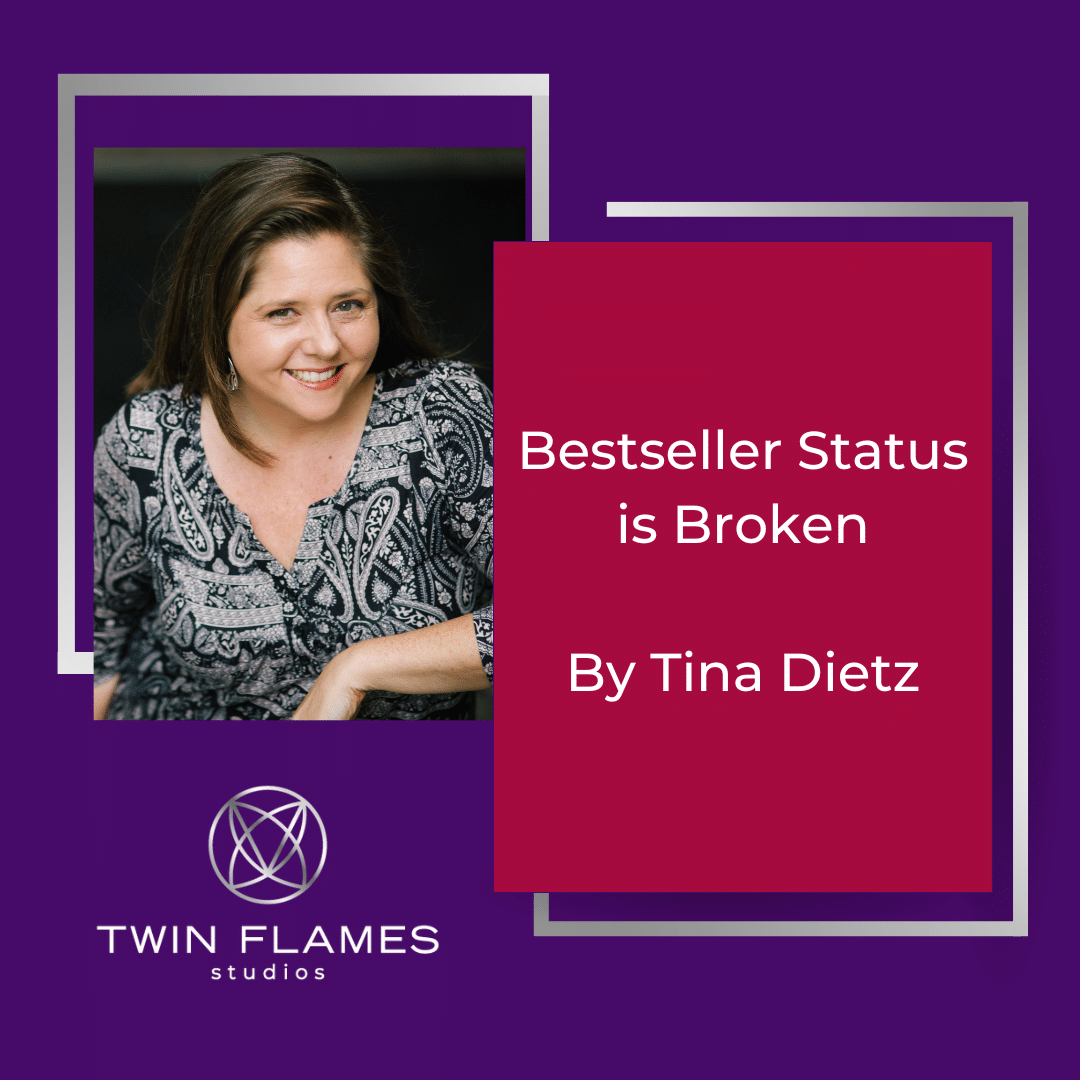
Headshot of Tina Dietz

Book Bestseller Status is Broken

Here's what authors should focus on instead.

You launched the book. You got the badge. You celebrated.
Then… nothing happened.

In 2025, “bestseller” doesn’t mean what it used to—and for most authors using their book to build a brand or business, chasing that badge might be the wrong goal entirely.

That’s the conversation we had during this month’s Twin Flames Studios Expert Panel, where I hosted three brilliant voices in modern publishing: Jenn T. Grace, Melanie Herschorn, and Robbie Samuels.

What we uncovered was part myth-busting, part strategy reset—and 100% necessary if you want your book to keep working for you after launch day.

The Bestseller Badge: Still Useful? Or Past its Prime?

Let’s get real: authors still want that badge. It feels good. It looks impressive. But the real question is—what does it actually do?

“It’s a confidence boost, not a marketing plan.”
— Melanie Herschorn

Getting the title of “bestselling author” can create credibility, especially with audiences who don’t know how the sausage is made. But as Jenn T. Grace reminded us:

“The average person doesn't know an author. So, when they meet one, and that person is a bestseller, they don’t know how it came to be.”
— Jenn T. Grace

There’s no shame in leveraging the title—but it shouldn’t be the only strategy you rely on.

“Bestsellers should be the byproduct of a strategically done launch.”
— Robbie Samuels

What Authors Should Focus on Instead

If you’re a coach, consultant, or expert using a book to grow your platform, our panel agreed on this: you need a strategy that creates long-term visibility—not just a short-term spike.

1. Build Your Email List

Your email list is your most powerful tool—and the only platform you truly own.

“You have full control over your mailing lists. They're safe, trackable, and you can do all kinds of sophisticated things with them down the road.”
— Jenn T. Grace

Jenn shared how she built a two-year nurture sequence for readers who download book bonuses—proving that list growth is a long game, not just a launch-week task.

2. Prioritize Reviews Over Rankings

Amazon’s bestseller ribbon can vanish within hours. But verified reviews stay, build trust, and drive sales.

“Reviews are social proof that stick. They influence buyers, podcasters, and event organizers.”
— Robbie Samuels

Focus on activating your audience to leave honest, verified reviews—especially during your soft launch or relaunch window.

3. Think Like a Platform, Not a Campaign

Your book isn’t a one-time event. It’s part of a larger visibility ecosystem.

“If you don’t have a marketing plan that already works, your book is like a rocket ship taking off and falling into the ocean.”
— Melanie Herschorn

Create momentum that goes beyond the launch—opt-ins, evergreen content, speaking outreach, even second-edition or audiobook relaunches.

Where Bestseller Still Belongs

 Bestseller status isn’t useless. But it should be one part of a bigger visibility strategy, not the whole goal.

“You can hit number one in some obscure category at 2am, but that doesn’t mean your book will do anything for your business.”
— Robbie Samuels

Use it as a credibility tool—but only when it's supported by real outcomes like engagement, email list growth, or speaking leads.

Use Awards as an Authority Multiplier

 If you want recognition that cuts through the noise, strategic awards may have more impact than a fleeting badge.

“If four of us wrote the same book, and one of us had ‘award-winning’ on the cover… that’s the one that would stand out.”
— Jenn T. Grace

Choose awards judged by real people. Look at past winners. Submit strategically—and use any recognition as a long-term brand asset.

Your Book Still Has a Job to Do

One of my favorite moments in the conversation was this:

“Your book doesn’t fall off a cliff. As long as it’s an evergreen topic, you can keep marketing it—even if it was written three years ago.”
— Melanie Herschorn

We see this all the time with our clients at Twin Flames Studios—especially those launching audiobooks years after their initial print release. With the right strategy, older books often perform better the second time around.

Let's Recap: What Actually Works in 2025

 If you’re serious about using your book to grow your business, here’s where to focus:

  • Email list growth (and an automation plan behind it)
  • Verified reviews (collected during a soft launch or relaunch)
  • Speaking engagements (with a clear positioning and pitch)
  • Awards and recognition (strategically chosen and submitted)
  • Audiobook relaunches (as a second chance to make a first impression)

You don’t need to be perfect. You just need a real plan that keeps working long after your book goes live.

Want in On Our Next Expert Panel?

Join our monthly series where we talk real-world publishing, visibility strategy, and the business of authorship—no fluff, just what’s working now. Reserve your spot here.

Final Thoughts

Your book is more than content. It’s a catalyst.

Whether you’re launching your first or relaunching your fifth, don’t just chase bestseller status.
Build a system that turns your book into long-term visibility, relationships, and results.

Your message matters. Let’s make sure people hear it.

What most surprised you, or what do you still want to know? Let us know your thoughts below!

About Tina Dietz:

Tina Dietz is an award-winning and internationally acclaimed speaker, audiobook publisher, podcast producer, and vocal leadership expert whose work and shows have been featured on media outlets including ABC, NBC, CBS, The Wall Street Journal and Chicago Tribune, Inc.com, and Forbes. She’s been named one of the top podcasters for entrepreneurs by INC.com, and Tina’s company, Twin Flames Studios, re-imagines thought leadership through podcasting and audiobooks for experts, executives, and founders.

How AI is Changing the Publishing Industry

The robots are coming…

And the publishing industry is welcoming them.

With its dramatic development over the past two years, artificial intelligence (AI) is reshaping everything from writing and editing to marketing and intellectual property rights.

As authors and experts, you are the ones who will decide whether AI is a replacement to be feared or a tool to be mastered.

One thing is for sure though: AI is not a far-off fantasy. 

That’s why I recently hosted some of the leading experts with experience in both authoring and publishing technologies: Thad Mcllroy, Elizabeth Ann West, and Jason Hamilton to discuss AI’s role in publishing and how you should navigate this important industry transformation.

The Current Landscape: Where Are We With AI in Publishing?

Is AI a  disruptive innovation or a passing fad?

As Thad McIlroy, publishing analyst and author of The AI Revolution in Book Publishing, put it: “They're still asleep at the wheel, and the car is moving very rapidly down the freeway.”

While some major publishers remain skeptical, independent authors and small presses are already leveraging AI to increase productivity and expand creative possibilities. 

For example, our live poll during the live panel showed an even split between attendees actively using AI and those still exploring. 

The Big Five Ways AI Is Disrupting the Publishing Industry

Writing and Creative Process

Elizabeth Ann West, bestselling author and founder of Future Fiction Academy, emphasized that “AI's biggest threat is not to publishers—but to authors who ignore it.”

 “Society needs authors using AI, not publishers,” she said. “With the right fine-tuning and prompting, AI can now generate publishable fiction that “makes you laugh, makes you cry.”

Jason Hamilton, author and founder of The Nerdy Novelist, encouraged creators to think bigger: “This isn’t about how to publish more books. Everybody can do that now. It’s about how we can do things that were never possible before.”

Editing and Productivity

If you need a burden lifted off your shoulders, AI is a useful tool to decrease stress and enhance workflow. 

By using fine-tuning, you can draft entire scenes or chapters, suggest structural edits, or mimic your own writing style with surprising accuracy.

Marketing and Book Descriptions

If marketing seems like the bane of your existence, you’re not alone. 

AI  is changing that.

Hamilton shared his method for generating high-quality book descriptions: “Find a top indie in your genre, break down their blurb sentence-by-sentence with AI, then build a template. Feed in your synopsis, and you're already in the top 10%.”

Legal & Ethical Considerations

There’s still a lot of confusion and concern about copyright. However, it’s helpful to note that risks are more about misinformation than infringement.

West broke it down: “You can't copyright AI-generated words—but you can copyright the selection and arrangement.” 

Think of it like fanfiction, where the author’s original additions are protected.

Thad McIlroy added, “The Copyright Office is misinterpreting the technology. What they're declaring is not realistic in this particular age of AI generation.”

Industry Dynamics and Market Saturation

AI is resulting in thousands of new books being published, but is the quality there yet?

AI is only as valuable as the person controlling it. Authors with a distinctive voice, a personal brand, and a strategy will prevail over the “AI slop” every time.

And if you’re a fan of niche genres, you’re in luck! If new technologies halve a book’s creation time, serving a smaller audience will be worth the hassle.

What Most Authors Miss

 AI shouldn’t be treated like a magic button.

Don’t fall into that trap.

Instead, West emphasizes integrity and diligence: “You want a tool that gives you control, not one that does it for you.”

How to Start Using AI (the Smart Way)

And above all: practice. The future of publishing is powered by AI. 

Success won't come from blind adoption or rejection. It will come from authors who are willing to learn, adapt, and keep their creative integrity front and center.

I can’t wait to see what you create next!

What most surprised you, or what do you still want to know? Let us know your thoughts below!

About Tina Dietz:

Tina Dietz is an award-winning and internationally acclaimed speaker, audiobook publisher, podcast producer, and vocal leadership expert whose work and shows have been featured on media outlets including ABC, NBC, CBS, The Wall Street Journal and Chicago Tribune, Inc.com, and Forbes. She’s been named one of the top podcasters for entrepreneurs by INC.com, and Tina’s company, Twin Flames Studios, re-imagines thought leadership through podcasting and audiobooks for experts, executives, and founders.