So you started a new business. Now what? In today’s highly competitive world, it’s important to find a way for your brand to stand out. And starting a podcast might be just what you need to get your brand ahead of the curve.
Podcasting is an inexpensive yet highly effective marketing tool that can help promote your brand. 24 percent of Americans listen to podcasts every month, with an average person listening to five different podcasts a week. One reason why podcasting is such a powerful medium is because it allows you to connect on a more personal level with your audience. Brands that use podcasts allow them to speak conversationally to their potential customers in a comfortable, trusting environment. Below we will look at how business owners can start a podcast to promote their new brand.
Test the waters with guesting opportunities
One of the best ways to introduce your brand to a new market is through being an interview guest. It’s a good way to test out the waters and see how audiences respond to your business. An audience’s initial response can help you craft a concept and format that works. Although you can’t just become a guest for any podcast, it’s important to find a show whose subject is appropriate for your brand. If you are a food-related business, you may consider educational shows that look at food trends. If you are a company focused on health and personal care, you might want to look for a podcast focused on helping people improve their wellbeing.
Come up with a name, concept and format
The first step to starting a podcast for your business is finding a niche. This will not be difficult as it should be something related to your brand. However, you must keep in mind that the topic should be broad enough that you can explore different aspects of it, yet narrow enough that you are able to attract an audience within that specific interest. For example, the podcast show “.future” by Microsoft is exploring how the future may unfold based on how our individual lives are today. The show looks at aspects of technology, health and data that influence the future we are moving toward. This fits Microsoft’s branding quite well since the company has always been looking at how to shape the future of society through their products.
Once you have come up with a topic, you can zero in on other details of the podcast such as the name of the show. It should be something catchy, short yet also descriptive. You will also need to decide on the format, which includes the length, structure and how often you will be publishing. The structure, such as solo shows, co-hosted shows or interview shows, will also need to be carefully decided on depending on what best allows your brand’s content to shine.
Make sure the business side of your brand is in order
You also need to ensure that the business aspect of your brand is in order before you begin marketing through podcast shows. This is especially important for startups and small businesses who have limited resources and manpower. It goes without saying that you should fine tune a strategy in marketing your primary product or service. You must also check that you have the right business structure that allows you to protect yourself. Starting a podcast opens you up to many potential liability issues that could shut down both the podcast and your brand. And if you are, like many starting business owners, a sole proprietorship, be aware that this business structure doesn’t protect you should your brand fail or you run into legal issues. Instead consider upgrading to a new structure. An LLC is a US business structure where the owners aren’t personally liable for the company’s debt and liabilities. Business structures such as these give you the freedom to invest in opportunities to grow your brand without the fear of anyone going after your personal assets. For online businesses, you must also make sure that your online platforms are in order and that the user experience is polished. This is because the idea is for customers to head to your website after listening to your podcasts.
If you are thinking about starting a podcast for your brand we hope these tips have helped.
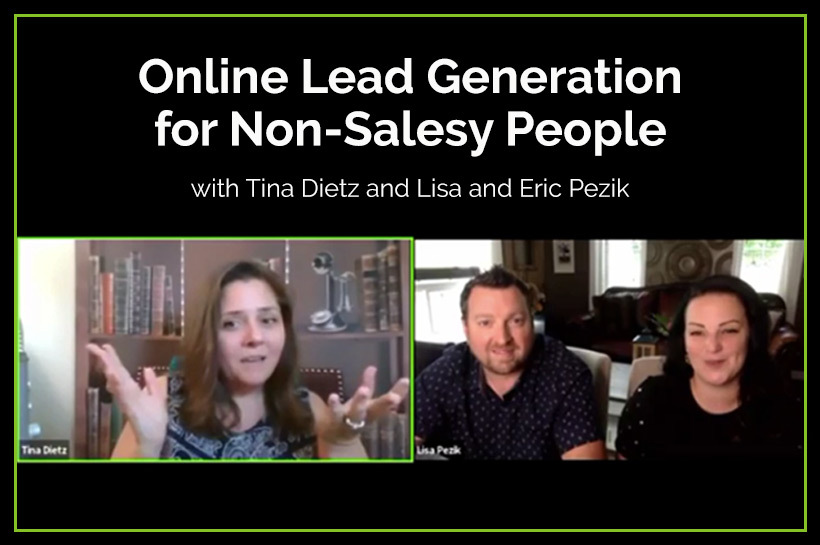
Tina Dietz talks to Lisa and Eric Pezik about online lead generation strategies for non-salesy folks that actually generate leads.Facebook Live, 2020
Tina Dietz talks to Lisa and Eric Pezik about strategies non-salesy folks can use to increase their visibility, draw in new audiences, and just overall generate more leads:
The important difference between lead generation and sales
How lead generation is often a long-term process
What looking for instant results can cost you in the long run
How “not-so-perfect” ads work better than professional ones
Why perseverance is key to lead generation success
Watch here:
Today, what we’re talking about is this big old buzzword we’ve been hearing it in business constantly. It’s gotten really intense this last year: Lead generation – online lead generation.
And particularly with a big surge in interest in LinkedIn. That’s been where there’s been a lot of the lead generation conversation. But it ties in with conversations about Facebook ads, and Amazon ads, and Google AdWords and all of these places, so we’re going to be talking about lead generation—what you really need to know, particularly if you’re not a salesy person.
If you’re somebody who has an established business, but the online world doesn’t quite work for you, you’re more of a relationship kind of person, you’re more interested in “belly-to-belly” conversations, but you’d like to be developing more business online in a way that feels good—that feels like you, that doesn’t feel like markety marketers marketing to marketers, as I often say.
I have here Lisa and Eric, my beautiful colleagues, hailing from the southern Ontario area—someplace I miss very much, that I used to spend an awful lot of time in. They have an absolutely gorgeous, gorgeous marketing agency that we’ve been sharing with our clients and colleagues, because I’m just so impressed with the work that you guys do. So thank you for joining me.
Aww! Thank you for having us!
Yeah! You guys have a number of different links—a number of different websites—so we’ll put those in the comments as we go along. Please note that I tagged both Lisa and Eric on their respective pages in the description of this video as well. So that’s all I want to say about that; let’s get into chatting about some good stuff here.
Actually I would love to have the audience get to know you guys during this conversation, rather than ask you what your background is and what you do. They can look you up—you’ve got an about page, all that good stuff.
Let’s get to the meat of the matter, which is, let’s talk about the difference between lead generation and sales, because I run into this in conversations with people all the time. They don’t know the difference between lead generation and sales. So Eric, would you start us off with that?
Yeah, absolutely. It’s such a common thing that people talk about, and I really connect with this. I don’t think that sales is sales—when it’s really not a sale. What I mean by that is, you say, “Eric, I’m going to be in your neck of the woods, and I’m looking for a really great sushi place.” I’m going to refer you to the sushi place that I love, and I’m gonna say, “You gotta check it out! this restaurant, it’s amazing. You’ll love it, they have killer sashimi, they have amazing rolls, here’s my favorite roll.”
Am I being salesy? Not at all. That’s sales, right? The lead gen side of that is the complete opposite. Now it’s, “Okay, well, how do I get someone as the restaurant owner into my sushi place?” Completely different. Right now, you need to build trust, you’re gonna have to be in front of people when they’re looking for sushi, and they’re googling for sushi. And that’s totally different. That’s the lead gen side.
I feel like what Tina was talking about, how people want to be belly-to-belly, and they feel like there’s the either/or: They feel like you’re either belly-to-belly, or you’re salesy. You’re either a relationship marketer, or you do lead generation. They feel like lead generation has no belly-to-belly “relationship personality.”And that’s what we do! We’re not just going to grab random people off the street and throw them in the sushi restaurant and say, “Hey, I hope you like this.” We do all the legwork to get those people who love sushi, who love Toronto, who love the culture, who love the type of sushi—there—and then as the business owner, is to do what you do best, which is serve the pants off people and build those relationships. Serve the sushi pants off people!
Sushi pants!?
Maybe that’s a thing!
It probably is. #SushiPants. Let’s do it.
But people don’t get to serve the sushi pants off people. They’re so busy trying to find those people that want sushi pants, who come few and far between.
That’s where this whole, “Lead generation didn’t work for me, it’s too much money, it’s too much effort” idea comes from. No, lead generation works—with people that know what they’re doing. What drives me crazy is the, “You’ll learn how to set up an ad and one hour and you’ll be up and you’ll be making money,” and everyone makes it sound so easy.
Yeah, so it’s the salesy part. This is—I’ll say it again, markety marketers marketing to marketers. It sounds like the fitness industry, you know—“Start a business in 30 days,” “Write a book in a weekend,” “Start a podcast overnight,” “Generate leads in your sleep”—all of these things can be done, but there is a quality conversation here.
It depends on what you are trying to create, both short-term and long-term. It also depends on what you already have in place. So I think it’s important for us to take a look at what is necessary before you start lead generation. What do you already need to have in place?
For example, I work with a lot of authors, and I don’t recommend lead generation, because all they have is a book. They don’t have a product, they don’t have a back-end yet. They’re publishing a book for credibility, and there’s a lot you can do with that in terms of book marketing, but there’s a difference between book marketing and business marketing. So when you’re working with people, what are some of the pitfalls that you run into? What should people have ready?
You don’t know what you don’t know. People come to us and they’re like, “We want to run an ad to this, and we’re like, “Okay, where’s your landing page?” “Oh, I don’t have one.” “Where’s your social account?” “Oh, I don’t have one.” “Where’s your website?” “Oh, I don’t have one.” “What are your products?” “I only have a book.” “Okay, then what if no one wants your book? Where are we going to take them?” Because lead generation is not a once and done, throw up some ads for 30 days, make you a million dollars. It is an ongoing process, that only gets better and better the longer you stick with it.
Everyone’s comfort level is different. So for me, I’m okay to spend $500 one month and $500 the next month and have zero sales, knowing that in the third month, I’m going to make two, three, four thousand dollars in sales, or I’m going to make that thousand dollars. I’m okay to hang with it longer, knowing that I’m building relationships. Other people are like, “If I spend $500, I want $500 back that same day. I spent $5 today, I want a $5 sale that day.”
And most business doesn’t work like that. Let’s face it, it really doesn’t work like that. You have to test, you have to find out what people want, what lands, what works, what doesn’t work, and you can only do that by doing it.
Right! That’s me—I don’t want to waste your dollars testing. I want to take your ad spend dollars and go. So you’ve got to know clearly who you are, what you do, what you offer, and have somewhat already established a brand, a business, a tagline, a voice, a message, a product, that you’ve somewhat trialled and run through on.
I like to say on Facebook, for example, people have got to see you. You’ve got to go live, you’ve got to be serving, and giving, and showing up, and being visible. You’re like a ghost and then all of a sudden, you’re like, “Buy my s***!”
Exactly! People are like, “Who are you? Why are you here? What are you doing?” Particularly if it’s a personal brand. Do you think we have a little bit more leeway on a product than a personal brand? I see new products pop up in my Facebook feed all the time.
That comes more down to if it’s a product, you really want to talk about the pain points and the benefits. Why are you different? It’s very similar. It’s just when you’re a personal brand, it’s about you. People buy on you, versus buying the product—”Why should I buy this product over that product? Here’s why.”
And the product is the experience! Nobody cares that the drill can drill into the hole in three seconds flat. People care that if I’m going to do a DIY project, I’m not going to kill my child when the playground system comes falling down on them, because this drill works so good. Or my honey is gonna love me, because I get this nice thing done in a day, as opposed to a year because I can’t figure my stuff out.
The product is the experience. The service is the experience, but it’s more the experience with a person. So people see you, they feel you, they know you, they understand you.
Yeah, so in both cases, it is a storytelling experience. You guys talk about this on your website, I talk about it all the time in my work. What’s the story that you’re telling? What’s the journey you’re taking people on? But yet, even if you’re telling a personal story, the story really isn’t about the storyteller, it’s about how it relates to the people that you’re talking to, and what’s important to them. It’s creating that connection. All storytelling, the purpose is to create connection and to draw people in into you.
So I think that the preparation of that, what you’re talking about—do you already have something proven? I think a lot of newer entrepreneurs get scared by this, because they have had all these messages that, “Oh, if you build authority by writing a book, or if you suddenly become a coach,” (We’ll talk about that another time!)—but really, “What are you good at?”
There’s a little bit of chicken or egg thing that happens when you don’t have a proven track record yet of doing that kind of thing. And I think that’s where building a network and building referrals—a lot of the relationship work—the podcast guesting we help people with. Certainly, the book side of things can help with all of that, but it has to be paired with all kinds of other things. And I know that you guys have a full service agency, so some of these things—the website building, the storytelling, the branding, all of that—if someone’s not ready for lead generation, you’ve got to back it up and help them with all of those things first. But what it really comes down to is, can you deliver on what you say?
Yeah! And being realistic. If you don’t have all that figured out, but you know this is gonna work, you know you’re gonna follow through, then be realistic that the first two or three months that we’re driving leads to you, we’re doing that “figuring out process” for you, which is worth every penny. It might take us three months, but it might have taken you three years.
Oh, definitely.
So even though maybe you’re not making sales, even though your ROI is sales, it’s figuring out what’s landing with your audience—and you’re getting more clarity in the process. So it shouldn’t keep you from doing it, because either way, it’s a win-win. It’s just you’ve got to be realistic with, “What is that win?” Everybody goes to money in their pocket. That’s the only thing that they say makes it work or doesn’t work. But you’ve got to change your mentality when it comes to that new generation.
And being realistic with what is the lifetime value of the client. We get that a lot. They don’t realise that you might work with us for three months and say, “Oh my God, I haven’t had a sale,” but then three months later, you might have fifty or a hundred sales that happen because that person followed you, and then when they decided to actually buy whatever you’re offering, you were the one that was there from the beginning six months ago, when they had that thought, “I’m gonna play in my backyard, I’m gonna do a landscaping job.” Well, you don’t just flick a switch and go, Oh, yeah, I’m gonna invest $30,000 in my backyard. It’s a six month, twelve month process.
Yeah! We had a lot of that with this current state of as we’re filming this, we’re still in the middle of the pandemic, and everyone’s like, “Shut down my ads, I’m done. I can’t run ads.” We’re like, “Wait, what? Why?” “Well nobody’s doing nothing. nobody’s buying nothing. Shut ‘er all down.”
So not true.
Yeah. What’s gonna happen if you all of a sudden disappear, and then you all of a sudden want to reappear again?
Then you’re messing with people’s heads.
A lot of people are spending time on their social media in front of their computer, researching. Planning. You don’t want to run ads? Says who? So again, you gotta think about what’s the end game? What’s the end goal? That lifetime value. They might not be ready today to purchase your service or buy your product, but six months from now, they may be!
It’s a whole thing about sticky branding, right? People do remember things. They’re more likely to look things up that they’ve seen in the past, or they’ve heard in the past, or that have been endorsed by other people that they do trust.
If you’ve already got an ad campaign going, and it has been producing results, it’s the people that I’ve seen in the last six months, as we’ve been dealing with this pandemic, who have really doubled down and pivoted appropriately, depending on their industry, and really made it even more about relationships, even more about serving people, even more about being helpful, that have done really, really well.
I know you guys have seen an expansion in your company, we’ve seen an expansion in our business. We’re in a position, being fully online businesses, we’re used to doing business online, that are in a position to help companies do things that aren’t in-person. That is something that has been a little nerve wracking for some of the companies that we’re working with, because they are highly professional and financial companies, private equity, very sensitive areas.
It may take a little while for them to make the leap, but once you get into a groove, once people start to trust who you are and what you’re saying, there’s a flow that happens with these lead generations. People can tell when you’re being authentic, and when you’re not. Even when it might be some type of automation or nurture campaign that may go out automatically. The storytelling that you guys do is so conversational, and so transparent, and I think that’s what makes the biggest difference in making what would normally look like marketing or advertising, feel good. That’s what we all want. We need to feel good when we see this.
Yes! And that is knowing your client. Like when you hear the word “agency,” we run a social media agency, we run a marketing agency, we run a done-for-you agency—at the beginning, I remember when you were saying that, “I don’t want to be called an agency! I don’t even want to be associated with that word.”
Because that’s like a production factory. Get you in, get you out, charge you astronomical amounts, good luck trying to get ahold of somebody. There’s no belly-to-belly personalization. That’s the complete opposite of us! We’re so individualized, we’re so deep-dive, and I think that’s where the best ads come from. When you know your client, you deep dive, you take the time to learn their stories, their brand emotions.
The not-so-perfect-ads tend to do a lot better than the perfectly makeup scripted, in front of my computer… The messy hair, walking down the street ads—people tune into because they’re real. And they’re relatable. You don’t have to be anyone you’re not, you don’t have to speak like you’re not. You just have to be you. And the right people connect to that.
Yeah, it comes across. It’s like connecting with people that you talk to for the first time. It’s either you’re gonna instantly feel that compassion, if they’re genuine people, or you’re just gonna be like, “No, forget it. I don’t relate.” And that’s totally fine.
And that’s why lead generation isn’t a start and stop kind of initiative. You don’t ever want to have that, “Oh, I’m gonna do that, I’m not gonna do that for two months, I’m gonna do another month, I’m not gonna do another one.” You’re not getting anywhere when you start and stop.
So I think when you’re in that position, that lead generation is right for you, have the budget for it. How many times do we say, “Okay let’s go,” and they’re like, “I have no budget.”
Well, what’s the budget that somebody might consider starting with? What would be, you know, a good range to start with? What should they set aside for, say, six months or a year? Just the ad spend is what I’m talking about.
We would start at like $500, and then we would scale it based on success,
Based on success, right. And so yeah, so from a $5,000 [total] marketing budget, that makes sense to me, because there’s a lot of done-for-you: The iterations, the testing, the research, the keywords, the audiences. There’s a lot of friggin details in the back end of that. I took a couple of classes on Facebook ads, because who hasn’t? And just the back end, the interface, was enough to make me want to go blind. That is not my world.
Yeah, like we tell people—we have a team of Facebook ads experts, and that is their job, to stay current, to stay around. If you are going to run ads on your own, $500 is a great ad spend to start with. You then have to be the one every single day going in there looking, testing, tweaking, staying on top of it, because you will burn through that if you don’t know what you’re doing. You’ll burn through that $500 faster than you clicked the button to put the ad on.
Some of the most successful people I’ve seen advertise on Facebook, particularly who were on the service side of things—you guys have a really fantastic specialty working with online businesses, but also working with local companies: Everything from local colleges, to gyms, to medical practices and things like that.
I think that’s really impressive, because that’s a big gap in the market—those types of companies. Clearly you’re able to do both, but I remember in a Q&A session with this person, because they very much had an “anyone can do it” conversation. And it was like, how much are you spending on ads on a daily basis?
They were spending $700 a day on ads, and they had a team doing it. It’s the same thing with these major launches, when you see all these people’s success, really important, prominent people. Jeff Walker—classic, right? The big launch guy, fantastic work, amazing work. It will take you six months to a year and $60,000 to run a full Jeff Walker launch campaign. Period.
The guy that I was learning from said, if you don’t have $5,000 a day to spend on ads, you’re not even playing in Facebook Ad Land. And I was like, “Did he say five dollars a day? Did he—he said $5k a day!?” I’m like, this isn’t my seat, because we started with $250 a month when we started running ads to my courses and programs.
What I like is why you don’t just want to guess and do it yourself, is our experts watch it. They’re very quick to say, “The $500 is your budget. We’ve already spent like 300 bucks, it’s not working. We need to try something different, we need to go somewhere else.” Like I said, you can burn through money. And that’s why people say Facebook ads don’t work. No—it’s you didn’t know what you’re doing, and you burn through your money, and now you got a bad feeling about that.
Yeah, even with just building our pages on Facebook. We have a page we built organically, we’ve got about 200,000 followers, and it’s a massive pain in the butt because Facebook is constantly changing things, so there’s a lot to it.
You know, you’ve mentioned a couple times, the value of done-for-you services, and my company with audiobooks and podcasting—we provide done-for-you as well. One of the reasons I decided to go in that direction was a survey I ran on audiobooks when I first started experimenting with audiobook services, because like most people coming out of the consulting world and the coaching world, my first thought was, “Oh, I’ll do a course, and people can do it themselves.”
I ran a survey with a bunch of my colleagues, about 50-60 people, ran them through it. There was a question that I put in there that said, “Which are you more likely to do? A. Take a course and do it yourself, B. Hire someone to do it for you, or C. Take a course, realize how much it is, then hire somebody to do it for you.” Almost everybody answered C, and put a note in about that question of, “Thank you for asking this because it actually brought to my attention that this is what I actually do.”
That’s when I decided I’ve got to do done-for-you services instead. Best decision I ever made as a business owner, both because it’s been great to develop the company and find out what’s needed, but also because it got down to an actual need that people had.
That’s it! A necessity. The people that understand done-for-you realize the cost of an action, the cost of trying to muck through and figure it out on your own—you’re not going to do it. It’s a necessity to move that mission bigger. That makes people go, “I gotta stay in my lane. I have no business tinkering around in the back end or Facebook ads thing. I have no business trying to do my own audio book thing and like, I gotta stay in my lane.” The people that make it a done-for-you service—they’re good at what they do! They’re not just random newbie developers; they are the best of the best of the best. It’s like, “We get you where you want to go—you don’t have the time. You can waste so much money so much time so much energy.”
I’ve done it myself, trying to do a lot of stuff myself. Let’s face it, we’re really smart people—we can figure a lot out. But doesn’t mean you should.
And that’s hard. When you’re Type A, you’re driven, you’re good, and you’re like, “I can do this—tell me I can’t, I’ll show you I can,” and that’s the curse of being really good. You can figure it out. You’re smart, you’re resourceful. You know how to ask for help. It’s like that badge of, I’m gonna sit here for 27 hours. figure this out, and then for what? And it’s like yeah is that battle you should be entering into—
—Or should you be spending that 27 hours having conversations with people that you could be helping, having them sign on to work with you, or bring them into your business or your company, and then having your clientele fund the done-for-you services, your marketing team, your PR your audio branding, whatever it is that you’re doing, so that you don’t have to.
I can’t tell you how many people are like, “I have $10,000. I need your help. But oh, well, I can’t work with you though, because I decided to put this into my book. Or I decided to put this into, I’m going to speak on stage—I paid to play and I’m going to speak on a stage, or I’m going on this TV interview.” The one shot wonder. There is no such thing as overnight success.
Media is so important. Having a book is important. All of these things are important. But they have to be in order.
Correct!
They need to be in order. Unfortunately, I see it a lot, too. That being said, this morning, wrote a couple of emails, referring some of my close colleagues to you guys, because I’m like, “You know what, they could really work with you guys, because they’re at a point in their company—they need to not be doing it themselves, but it doesn’t make sense to hire like a single marketing person.”
A single person can’t do everything on their own. Having the backing of a team is really important, and finding a good marketing agency is—that’s one of the reasons why I wanted to bring you on this live today—is that I only have a few companies that I will refer people to for marketing services. That’s based on my 20 years in business and having been burned and being really very suspicious—very suspicious Type A over here—on things.
I even have a referral partner of mine—today, they sent me some information about information they wanted me to put out there. And I sent it back to them some feedback: I’m like, your terms and conditions aren’t clear, and your disclaimer, it actually isn’t legally responsible for you to say some of those things. So I can’t promote this, because my people are going to have questions that I can’t answer, and you’re not giving me an opportunity to send them to anyone to answer questions. You just want them to click “Buy Now.” And I’m never gonna send somebody to a “Buy Now” button that’s five to fifty thousand dollars, without the opportunity for somebody to have a conversation. I wouldn’t do business like that.
Yes. People don’t want to take the time. You have to take the time. You have to treat it like it’s your business—like that business decision is a decision that you would make in your business. And if you don’t like being rushed, why would you rush somebody else?
Exactly.
Give people all the information. It might not seem like a life or death, make it or break it conversation to you, but it may be for that person staring back at the screen. We never push our people into making decisions. We educate and we take as much time as we need till they feel comfortable one way or another.
I’ve seen you do it! For sure.
Well, I wanted to see if I could kind of wrap up some last words of wisdom here and circle back around to this whole idea of a checklist or a couple of pieces that people need to actually make online lead generation effective. What are a few things that we really want people to know—that they ought to have, or ought to work on, and obviously they can reach out to you guys too, or reach out to me for more.
A few things. Definitely have multiple offers. Think about how you can take one particular thing and make it three different things, but yet, it’s still the same thing. That’s critical, because we get that a lot, where you say this thing’s 99 bucks, and you think that everyone’s gonna buy it because you think it’s the greatest thing. At the same time, maybe that 99 bucks, instead of saying it’s $99, you turn around and say, “You know what, I’ll give you free shipping.” So there’s two offers right there. So think of it that way. Crafted uniquely, so when you put it out there to the public, you’ve got places to go and different things to try.
Because a lot of people will say, “It didn’t work.” “What did you try?” “I put it on for 99 bucks, nobody bought it. It’s the price, but this thing’s worth a million bucks.” So I’d say that’s number one.
Number two is, make sure you have proper branding. Make sure you have something that someone’s gonna trust. We always find that people think that people aren’t paying attention because they didn’t click like or because they didn’t comment. Biggest BS! People are always watching. People are always paying attention. You probably have the same friends like we do where all of a sudden, we won’t see friends for six months. Next thing you know, they’re like, “Hey, yeah, I saw that you had oysters yesterday! Where’d you get those oysters from?” You’re like, “What?!”
So just remember a big takeaway from Eric. They’re always watching. It’s true, though. It’s absolutely true, and I think that goes back to your analogy from the beginning of our conversation about the sushi restaurant as well. You not think about having sushi for three, four or five months at a time, but when you have a craving for it, you know exactly where to go because of that recommendation that you got from a friend, or because of the ad that you saw, or the coupon you got in the in the paper or the recommendations you saw on TripAdvisor. It sticks with you, and that goes by just what you said—that sticky branding. It’s about that branding that stays with you over time. Anything else?
My last thing, no matter what you think is or isn’t working, stay at it. Stay at it, and get out of your own way, because you’re not the one that gets to decide that. It’s your buyers, it’s your audience—they’re the ones who will decide for you. So just stay in your pay lane and keep doing what you’re doing, whatever that is. It’ll end up paying off dividends in the long run. We see people give up really quickly—they’ll try for two weeks, three weeks, and then we’re like, “No, no, you gotta give it like, three years before you can really say something did or didn’t work.”
I give it six months.
I agree.
I know if I’m gonna say yes to running an ad, any campaign, any process, I know I’m in this for six months. It’s too early to bail on it—to say it worked or didn’t work. You don’t have enough data.
And I was gonna say make sure everything matches. If you run it, and it doesn’t look and feel—it looks and feels and sounds one way, and then they hit your landing page or your website, and it looks and feels and sounds a different way—that’s going to cause an instant, people are gonna be like, “Whoa!”
Oh, no, that will cause an instant pivot to everything. I’m actually in the midst of a fitness program right now, and I know the fitness industry. I have a hard time joining programs with it because of the marketing that gets done with that. This company is no exception—I won’t name them. Their products are good, and it’s like, “Oh, I’m going to show you in 30 seconds how to do something,” and it takes you to a 15 minute sales webinar. Every day, an email that’s like that, usually selling a supplement, selling a meal plan, it’s like, “Oh, we’re going to give you everything you need, we’re going to give you the recipes, we’re going to give you this, we’re going to give you that.”
No. They’re going to give you one list of recipes, and then they’re gonna sell you a personalized meal plan every damn day. So this is why this personal connection and taking the time with people, and managing expectations is so important, particularly in this realm. I know we agree that transparency is so important.There’s lots of places that you can go out there, my dear friends out in Facebook Land, where people are going to tell you where you want to hear. Your friends will tell you what you want to hear. Don’t ask your friends for feedback on things. Ask people that you respect, that are successful, for feedback.
Go out and ask three marketing agencies to give you feedback and see what the commonality is between the three. You’ll find the intersection of where you’re falling down on the job. But when you’re talking about doing business with a company, make sure they’re willing to take the time with you. (I mean, be respectful of their time of course, we don’t have all damn day!) But nonetheless, someone that’s willing to work with you and is willing to shoot straight with you and say, “You’re not ready for this yet. This is actually where you need to be.” It’s not because they necessarily want to sell you something more, it’s because they want your initiative to be successful.
Yeah, hundred percent. Lastly, I would say have a process in place for follow-up. Because even though everyone thinks lead generation equals automated sales—
—That’s a story, tell the story!
Okay, so we have this lovely client who we love dearly, and she worked at a gym. She’s a nutritionist, and people were just giving to her, as part of the package, amazing testimonials, a ton of success stories. A perfected process: Check, check, check. Now she’s running ads to a webinar to an application to work one-to-one with her so she wants to do it on our own. Because helping all these people, getting paid X amount at the gym—that’s how you know you’re an entrepreneur when you’re like, “Wait a second—”
“I’m pretty sure I can do this better on my own! Shouldn’t I get paid more for this?”
Right! But the legwork was done for those people—the trust was built, the qualified leads were already there, whether they liked it or not. There were people that were saying to her, “I don’t even know why I’m in this office with you. I’m here because I have to be. I don’t really want to do this.” They end up being her best testimonials.
But now you know, we have over 100 people that have watched that webinar and we’re like, “You got a goal, but the sales—‘Oh well?’ You got to go back to those hundred people! You got to go back and say, Hey, the belly-to-belly! The personalization! What was the biggest thing that made you click into that webinar? Was there anything in there that resonated with you, anything that didn’t resonate with you? What are you looking for? What are your worries and your fears about hiring someone like me? Like you? What do you need to know for us to be able to help you?”
Instead of the “Watch the webinar, do the application, click it, buy it.” You can’t duplicate the same process—well you can, but there’s more legwork and belly-to-belly work that has to be done. You have to follow up. So even though everyone leading to you was automated, when it’s a service-based high ticket, sometimes there’s a conversation that’s required. When you’ve got 100 people that want to work with you, And you’re the lag in your own way, because you don’t want to have a conversation, come on.
That’s a problem. You’re really shooting yourself in the foot.
Yes. You have to do this much. Don’t let this be the month that makes it not work.
Yeah, you might be missing the office. Right? Like you think about the analogy behind that. The reason why her biggest success was at the gym was because she got people into her office. And that office they got a relationship, into intimacy. We all get nutrition, we all get health. We all get that we need to work out, eat better, and drink water. But you know, you need that next level—you need someone to tell you how to do it.
You need to trust someone enough to say “Yes, I’ll do it with you.”
That’s very true. There’s a lot of choices out there. There’s a tremendous amount of information.
How much money have we spent on health products? MLM. Training. And she makes the claim which is valid, and I believe her, that “I want to be the last nutritionist you ever work with.”
I love that.
“I teach you about how to do it for life. I teach you how to truly live in tune with your body.” I’m like, “And then there’s 100 people that need you! Get your butt on the phone!”
Yeah, so maybe my next one of these Facebook Lives I’ll do something on closing! Because that’s one of my favourites. Lead gen and sales—remember this—not the same thing. Also your website, your offers, your products—not the same thing as your marketing in your lead generation.
So all of these things are pieces of a puzzle—they’re like Legos. You’re building a house as colourful and as interesting and as weird as you want it to be, but that doesn’t mean you don’t need the architecture. So if you’re looking for more architecture, for your business, and to help with the marketing, to help with the lead generation, and you really want someone who’s going to tell you—”Do this, don’t do that”—talk to Lisa and Eric. They’ll tell you what you need to know. And I do trust wholeheartedly that you’ll be fully taken care of.
I appreciate you guys being here today and joining me for this collaboration conversation here on Facebook Live. And we’ll be also sharing this out with our other networks as well. So I’ll see you all over “the Internets.”
Thank you so much for having us!
Oh, my pleasure. We’ll talk to you soon, guys. Thanks!
Lisa Pezik
Eric Pezik
Lisa, her husband Eric Pezik, and their team specialize in done for you services with branding, content creation, funnels, and websites, with their agency Infinite Design House. They also offer SEO, blogs, social media, and lead generation with their Sales Booster Program. They do all the things you don’t know how to do or don’t want to do in the online space!
Here are five steps you, as a content generator, can take to find your book inside your blog (and inside your other content, too.)
“We all have a book inside us,” as Dana Micheli, fellow ghostwriter points out. I agree with her, but I also believe that content generators, who are practically manifesting material in their sleep, already have a book outside of them. They just don’t know it…yet.
I consider a content generator a business owner or entrepreneur with an abundant blog, LinkedIn articles for days, keynote addresses and speeches filling up digital file folders, transcripts of every interview they’ve ever done (podcast or otherwise), and copies of any free eBook, presentation, or article they’ve ever written. Whether they’ve generated all this content themselves, or benefited from the support and talent from content writers, copywriters, and/or ghostwriters, the fact is this: They are sitting on a content gold mine, each piece a precious gem, and part of a book just waiting to be produced.
I’m fortunate to work with clients who believe in the power of content and who leverage me to help grow and nurture their mines. Most of them want to produce their first book (or next) but struggle with repurposing their content or searching for the parts and pieces to produce a book—a book that is focused, well-written, showcases their expertise, offers value to their audience, and boosts their business credibility and brand.
Here are five steps a content generator can take to find a book inside their blog (and any of their other content, too).
STEP 1: Identify Topical or Thematic Threads and Trends
List all the places where content exists and visit these locations. Review headings (and subheadings) and scan your content. Note keywords and other recurring ideas that you notice.
Rank your discovered themes/topics and choose the one that speaks to you the most, or aligns with your brand and vision for your business. By going through this process, you’ve found the focus of your book. (You’ll also likely find the most precious gems: the stuff you once wrote that really shined above the rest. Hopefully, those pieces make it into your final work.)
STEP 2: Define Your Reader and Relevance
Now that you’ve identified your topic, pull together copies of each piece of related content. Scan the content and ask yourself: who is my ideal audience? Why is this topic relevant to them? What will they get in reading this information? How is it different and new from what already exists? To take this one step further, envision all this content in its final version (a beautiful book with your name on it) and reflect on what your intended goals / hopes / outcomes are for this book.
STEP 3: Outline Your Table of Contents
Determine where you believe you want your reader to begin and to end. Mark the beginning as A on a piece of paper, and write B on the other side. You’ll fill in the outline of A to B as you read your content again, and this will become your table of contents. Now, this time, you’re not going to just look at content online. Print everything relevant to your topic. Read each piece then set it aside (temporarily). Yes, this may take you some time. You’re mining for the gold here. What are the relevant pieces that really stand out? How do you see these pieces creating an arc of the work? Organize your content based on how to get the reader from point A to B. List the titles of each individual piece in your outline according to how you think they should be ordered.
STEP 4: Investigate Gaps and Goodness
Pinpoint what’s missing and what’s already kicking butt. Read your content from start to finish in the order you outlined. Record what is working (‘goodness’) about what isn’t (‘gaps’). Make a plan for addressing the gaps. This may mean reading it out loud to yourself, taking some time away from the draft, running it through spell check, asking a friend to proofread, etc.
STEP 5: Polish Before Your Publish
Polish your work so it’s crystal clear and shines like a diamond. It’s time to fine-tune things before you publish—no matter what publication route you go. When you’ve finished addressing the gaps, read the full manuscript for clarity, cohesion, and flow. Mark the text where adjustments need to be made. Proofread with an eye for spelling, grammar, punctuation, etc., and review for formatting and styling consistency. Solicit the feedback of others you trust to give you a professional and critical eye, and assess if you achieved your goals.
You have now finished mining a book out of your voluminous mountain of content.
If you need some extra support with these five steps, you can snatch up my free gift, Finding Your Book Inside Your Blog: A Content Master’s Scavenger Hunt & Field Guide to Find the Pieces to Produce Your Book.
Alyssa Berthiaume is a native Vermonter, professional (and creative) writer, practicing feminist, recovering middle child, wannabe superhero, and a mom who’s pretty sure she’s “winging it” most of the time. She’s the leading Lady (Boss) and ghostwriter at The Write Place, Right Time – her virtual boutique of writing services for badass coaches, trainers, and speakers, and other badass entrepreneurs who don’t “do words” but know they need them. To know more about how she can “do words” for you, visit her website.
Alyssa Berthiaume– Copywriting, Ghostwriting, Lady Boss and Owner of The Write Place, Right Time
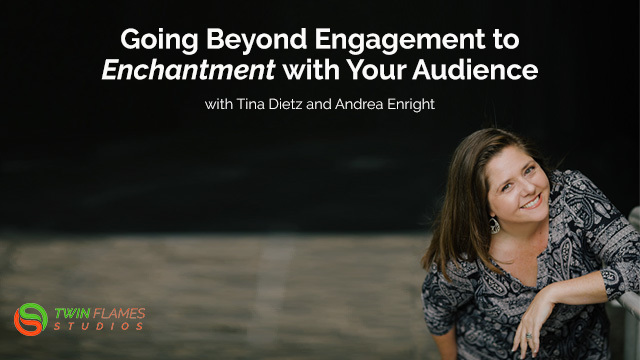
Tina Dietz talks to Andrea Enright about the importance of not just engaging, but enchanting, your audience.(Facebook Live, August 11, 2020)
Tina Dietz talks to Andrea Enright about the importance of not just engaging, but enchanting, your audience. They discuss:
How “engagement” has become a social media buzzword
How it’s vital to make people understand what you provide, not just what you do
The importance of being authentic
Tips for improving your profile and presence on LinkedIn
The value of stories for creating enchantment—but avoiding the “Once upon a time” trope!
Listen below:
Hey everybody!
Since I’m posting this publicly, I’ll introduce myself really quickly. And then of course, my beautiful friend and colleague here.
So those of you don’t know me, I’m Tina Dietz, I’m the owner and CEO of Twin Flames Studios. I have been building businesses for many decades internationally, but what me and my company do best is unleash the voices of trusted brands and companies, executives, and leaders worldwide. We do that primarily through audiobooks, podcasting, and vocal leadership.
I’ve decided to go ahead and talk with some of my colleagues live—we have all these conversations that happen in the background, I know all these amazing human beings who are out doing incredible work in the world and I thought, “Well, you know what, why not share some of this awesome with the world?”
This is Andrea Enright from The Boot Factor—and I’ll tell you more about her in just a second—but Andrea and I had gotten to talking about the proliferation, the outrageous number of people claiming to be LinkedIn experts that is happening lately. And all the mistakes that people make in their branding and their messaging, and how tired we are of certain conversations in the industries that we work in with consulting and coaching and service industry professionals.
We work a lot with the financial industries, and with high end consultants, with healthcare organizations—pharmaceutical—and training organizations. So you know, we have all these inside conversations; now we’re bringing it back out to you and today what we’re talking about primarily is the conversation around engagement: “Well you have to create an engagement on social media!”
Are you tired of that? I’m tired of this.
Buzzword, buzzword, buzzword!
It’s such a buzzword right?
Let me tell you more about Andrea before we get into this. So Andrea, has been an entrepreneur since 2002. And much like myself, she has a checkered past…
Well, they’s fun questions to come. That’s what we call a hook!
Love it!
But she’s been working, beautifully, with coaches, with consultants, a lot of folks coming out of the corporate world becoming consultants, and helping them to clarify their message—”Please god, clarify your message”—and get your message out there, in these badass elevator pitches, making sure that your LinkedIn profile is, I’m gonna use a really horrible term, “on fleek.”
But making sure that it is beautiful and pristine and represents exactly who you are. We’ll talk a little bit more about how that gets done. Because that is an art and a science. And she’s just a really cool person to hang out with. I love her because she’s no BS. That’s what we’re mostly talking about here.
So, thank you for joining me here today. We were having some technical issues with Facebook Live, so thanks for hanging with me through that.
Thanks, Tina!
Yeah. Sorry, do you want me to—should I talk about—
No! Talk. Absolutely! Go ahead. I’d love to have you go and dive in. I’m curious, what did I miss?
I mean… I really work with coaches and executives, and really helping people get brave with their brand, basically. When you get brave, then you get to something called, what I’m starting to call, “Leads In,” which is getting Lead Gen without freaking out, you know?
Yes!
Without the panic! So, if you can get to your authentic self, and you can get brave, and you can show up and get vulnerable and show just a little bit of lack of perfection because nobody wants to see that—we’re totally bored with it. We’re not interested in a long list of achievements.
And I think… Here, how about this? This is really what it sums up—most LinkedIn profiles start out with, like, “I’m not sure how to tell you this, but I’m kind of a big deal.” Right?
Yeah, actually, mine does. I know mine’s up for an evaluation. That’s one of the reasons you and I have been talking And I haven’t updated it yet. Because I’m intending to have your badassery all over it! So, that was the way it got done.
And it’s the same way with webinars and things like that, you know? Speaking from my own experience: I’ve had to talk to a number of clients in the vocal leadership side of things to please, please, please tell a human story. Don’t spend twenty minutes talking about your long list of how perfect your life is before you actually teach anything or share anything or give people any value about why they’re there.
Right! To give people credit—to not totally throw everyone under the bus—LinkedIn was set up originally as like this resume place, right? Like this job seeking place. So people are like, “Oh my gosh, I better put everything that’s amazing about me in a long boring list, like a play-by-play timeline of your life.” And guess what? Nobody cares!
Yep.
Just please summarize for me, because I’m not getting past the third line.
Yeah, and that’s it. Our attention spans are like that of a gnat, pretty much, online these days. And, well, here’s what here’s one of my other favorites: I’m sorry, guys. We’re not trying to totally throw you on the bus here. If you have any of these things, it’s okay. We’re all human. It’s a good time. But you know, how about how about this? This pose!
It’s true! I think people get really self conscious about “How am I supposed to look?” It can be okay. If you’re looking authentic, if your teeth are showing, if you’re smiling, if your face is taking 60% of the frame.
Yes—please.
Then you’re good. I don’t care what you’re doing. But yeah, there is a pose—a perfection about it. And people are just not interested in that. And now LinkedIn is going from like resume to resource, like, “How can you be of value?”
Yes! From resume to resource! Let’s talk about that. We’ve been doing some different things on LinkedIn this year and really doubling down on using LinkedIn.
We’ve been using LinkedIn a lot in the background and now it’s kind of having a resurgence. I think for a long time, LinkedIn was a bit of the redheaded stepchild of the social media world, and now it’s having a resurgence because so many more companies—we’re business to business companies, and us marketing high-end services on Facebook does not work. Same with Twitter. Forget it.
Yes!
It’s noise. It’s just noise. So we’ve been having a lot of a tremendous engagement—hopefully enchantment, we shall see—with folks. And getting tremendous reach on our post, sometimes up to 65, 70,000 people seeing our posts! But it takes a lot of time to craft these messages, and get things out there. Fortunately, I have a fabulous team and they’re really helping to repurpose content, get things out there every day on a regular basis.
But you know, where do you think people should start? Do you start with the content? Do you start with your profile? Chicken/egg.
I want to talk about the posting because I think there’s a big shift that needs to happen with the posting. But the profile is really where you start. That’s where you should start with anything. If you are a high-end coach, executive turn consultant, speaker, author—people are googling you, they’re finding you, please start with your profile, and turn that into a resource instead of a resume.
So, how can you give a soft sell and create Thought Leadership, and give them something that they can use in their meeting today at 3 o’clock—and this is amazing! This makes them think, “Oh, wow! She knows what she’s talking about,” and “Oh, wow! I’m going to call her anyway.” They’re not going to go implement your shit with this “three tips” that you give them. If they’re serious, they’re gonna call you. So this is really just—it’s giving. It’s giving stuff away and being okay with that. It’s serving instead of selling.
Serving instead of selling. That really is the key, and I think that it’s also important if that feels like a foreign concept for people. Because every so often, most of the people that we work with are heavily service-oriented, heavily relationship-oriented. They’re used to doing a lot of business what we would call “belly-to-belly.” But I think a lot of folks have a difficulty translating that to online, particularly our podcasting clients.
We work with a lot of folks who are very high touch, very white glove, wealth managers and consultants, who really spend a lot of time cultivating relationships with their clients. So when you go into a social media situation, it feels sometimes to them—not only like the Wild West, but like a foreign entity, like a different language they have to speak.
We talk about being vulnerable. We talk about being authentic. But for somebody who’s having these long conversations with people, how does that translate?
This has been a perfect segway because of Zoom, because of having to switch to Zoom. So, people are like “I meet my clients face to face, I can’t give them this custom thing. How do I do this?” And really, I think it used to be building a LinkedIn profile to get people to know, like, and trust you—
Yes, classic.
—and that was, like Dale Carnegie. It’s like, Okay, “How can I get get those people in,” right? But now it has to be these three things, I believe, these three pillars. Mine are: Translate, Educate, and Enchant.
So, we Translate that message; and the biggest way we do that is, because we’re not face to face with them and we can’t see, we can’t go off their cues—we are not in real time—we have to Translate that message, and we have to think, “How can I think of it in terms of how they’re thinking about it.” Not “how I’m thinking about selling it,” because nobody wants to be sold to. “How can I think about it in terms of them receiving it?”
What is their pain? What’s keeping them up at night? What is the wound that they have that they can that they cannot get past? What is hurting? And what will then make them think of that message in a translated way. So, Translate is really that first one.
Yeah, Translate very, very important there.
And here’s the other thing. You mentioned something we talk about a lot in marketing, on the marketing side of things, which is pain points. I, personally, am pretty uncomfortable with the terminology of that, and a lot of my clients are as well. So, I want to translate that piece as well. Because classically, we do talk about pain points and identifying their pain or their wounds, and things like that. I want to counteroffer something here and say, you know, it might not be something that keeps people up at night, but what’s the itch they can’t seem to scratch? Or what do they have questions about? What are they curious about?
It really is all about putting yourself in the other person’s shoes. My clients are doing well. They’re doing well for themselves. They’re really out there helping other people. But if I were to talk with them and say, “You have to have a podcast or everything’s going to hell,” that’s never going to happen.
Okay, that is a great point, and I think pain points can matter. Two things come to mind. One is that I recently redefined for me the definition of… redefined “brave,” because “brave” used to be like, being scared and doing it anyway. Guess what? That’s really not good advice for a teenager who’s just about to enter—
Yeah, it’s a little bit psychopathic on occasion.
Right! Like “Oh, you’re afraid, but keep going!” So instead, I think it’s this inner knowing or this inner voice, and I think a lot of my clients’ pain—it hurts not that bad, but they know that something’s off. They know they haven’t tended to something, they know there’s a voice that’s—that they’re hearing these whispers. So, I think when you have that inner knowing, that also moves you into that brave position, and into that position where you’re like, “Look, I’ve got a change, I’ve got to change something. I have to go that extra step.”
That makes total sense. I had a really important turning point in my life a couple of years ago, where I realized that I had this background mantra of “I’m fine; it’ll be fine. I’m fine; it’ll be fine.” That’s a really good thing if you’re just looking to evaluate something and truly let it go, but I realized that I had spent a lot of my life talking myself into things being fine when they weren’t fine.
Right. Right.
And so, I think it’s important, if you are listening to this right now, if you’re watching this right now, and you hear yourself trying to talk yourself into something that “It’ll be fine. It’ll work out.” That is a red flag.
It’s a great point, and I think that leads me to this “fear abundance.” When I’m talking to people, when I’m helping them establish their brand, and they’re wanting to sell—I’m like “I’m not going to outlaw it, but let’s try not to wrangle our clients, or potential clients, into a position of fear.” Like, “Oh, my God, if we don’t do this, things are going to be over.”
Yes.
You don’t want to instill that kind of fear. I really want to get them out of the trance of scarcity and toward a mindset of abundance, right? There is more; there can be more. You can find more. And so, I think that’s important as well.
Yeah, I couldn’t agree more.
So what are some of the other things that you tend to see—and we’ll stick with LinkedIn for right now because it’s a good focal point for us to look at—especially if we’re considering that how you do one thing is how you do everything. It is a place where we’re focusing on showcasing ourselves as well as our businesses: Who are you, as an individual, as a leader, as a CEO, as a consultant.
But truly, we’re not looking at business pages, or company pages, the same way we tend to look at individual profiles. So what are you seeing that people are missing the mark on this?
A couple things. One is they’re thinking of themselves very firmly attached to the job that they currently have. When you do that, and then that job ends, and then your life will shift. So what we have to do on LinkedIn—and with a personal brand—is really talk about yourself, and brand yourself, in a way that is connected but independent of your job, right? So then when you’re moving on, when you’re moving up, when you’re moving over, those skills are much more easily translated.
I see people describing what they do in their job instead of what they do around their job, and for the company. So it’s task oriented instead of outcome oriented. I think I’m definitely seeing that as a mistake.
That’s a really important focal point, and I want to build onto what you’re saying. On the podcasting side of things, we often work with folks who are emerging—in their thought leadership, in their vocal leadership, in their messaging—and we see the same thing: I have a client right now, actually, who is still so firmly ensconced in the corporate world, does a great job there, has been there for 15 years, but he has a whole other company that he’s been developing on the side.
So, the dance he has to dance is in speaking broadly about who he is, what he stands for, what his values are, and—rather than a lot of how to, or any kind of pitching or things like that—and that’s a that’s a real mindset shift.
It really is. I’ve seen people do that though—you really can go from, “Well, what am I really bringing to the table on the board position I have, in my company, in my side business? Why am I valued?” Then going from there, we see that people are putting their positions. They’re just treating it as a resume. Instead of a headline at the top, I see a position. It really, in my opinion, should be a headline. It should be who you help, what you actually give. Not advice; you give peace of mind. Not a massage; you give out relaxation.
Translate what you do into what people are really getting, and try to lead with that. Positions mean less than they ever have, because they hand out positions because they can’t pay you more sometimes. Isn’t that true? I mean, your executive title does matter, but that doesn’t really tell me how you’re any different from the other VP. So you can have your position, but then I want to know more. I want to really know the hard skill and the soft skill of what you’re bringing to the table.
And I want to give a shout out. A lot of what I’ve learned is from my LinkedIn coach Ellen McLemore. She’s amazing. She really has helped shift my mindset on LinkedIn, and that’s been that’s been huge. It is really a mindset shift.
You know, one of the things that just occurred to me is the concept of elevator pitches. Which is something you work a lot with as well?
Yeah!
How does that interact with something like LinkedIn, or does it at all?
I think it really does. You have to remember that it’s all about context, so when I’m sitting next to someone on a plane (in my non-COVID life), I need to have an elevator pitch that is a hook, and it’s just enough for someone to turn their head and say, “Tell me more.” Or if I’m on a networking event, or if I’m a Zoom call.
But on a LinkedIn page, it’s much different. We’ve got the scroll, we’ve got someone clicking, we’ve got someone distracted by their other tabs, and so we have to go in these little bits—and they’re going to scan them. I do think the elevator pitch absolutely should be woven into the LinkedIn profile, but I would try to squeeze in some of those words I usually use into your headline. That’s where I put them first, because that once you get into your “About” section it’s a much different formula.
Yeah, I think that makes a lot of sense. So then coming back to our original topic of this idea of going from Engagement to Enchantment, what do you think are the differences between the two? We’ve seen a lot of engagement on things, but whether somebody leaves “enchanted” or not—
Yeah!
—Customers or clients certainly do, but what about interactions out in the world on a daily basis?
There’s a few things we can do, to do this. Engagement is like, “Hey, I’m paying attention,” which is what we want everyone to do. To me it’s like a bare minimum of having a conversation. “Is someone paying attention to me? Okay, I’ll keep talking,” which to be honest, I’m not super comfortable doing. If they’re just gonna stand there, and keep talking just because, okay, I got their attention—I want more, and so it’s just not enough.
To really create what I call “Enchantment,” we are going to take them by the hand and lead them on a journey. We are going to look them directly in the eye and create an intimate conversation. We are going to make them feel as though we are talking directly to them. We do that by getting human: by using human phrases, by really resonating with not just their head, but also their heart—
Yeah!
—and getting vulnerable. Most people are. Why this is hard, is, it’s scary to be vulnerable—people are a little afraid to put themselves out there, and they’re also very afraid to be specific—to really talk to that one target audience person that you want to reach.
Right! That idea of “Well, if I niche down, I might miss someone or something.” That’s another indication that your mindset may be a little less than abundant, perhaps, and that’s okay. We all do this. Like we hit these walls, we hit these ceilings of everything that we do.I think this is also a really good place to remind people that you don’t constantly have to be telling a deeply intimate personal story—you can just tell a story. This is the storytelling portion of things. It’s not “Once upon a time…” necessarily, but this whole idea of creating intimacy, creating connection, and creating authentic, heart centered, alignment with another human being. That is, we connect with these little stories. We’re all wired for stories.
I would say even that storytelling’s become such a buzzword. The problem is that not everybody’s good at telling a story, and that’s okay. Not everyone’s a storyteller, and so one trick is to remember what you said—it doesn’t have to be vulnerable.For example, in my profile, I used to say something like, “There’s nothing I love more than mining you for your magic and building you a great brand.” And then I say, “Except maybe chips and salsa, but otherwise you’re number one!” It just gets a giggle, right? It’s sharing something about me that’s not vulnerable or secret or anything, I just like chips and salsa!
But it makes me like a human instead of a company, and people just they just respond to that!
Right, exactly. Yeah. as well. Another point in your bio, you say, you know, you speak to audiences—speak and sometimes swear, in front of audiences—I do the same thing. The little bit of human internal conversation with these little moments that create connection and create this sense of “Oh, I know you.”
Right! Like, “Oh, I know you! You’re like my neighbor” or “I know you! You’re like my daughter.” Like there’s a resonance there. I think you really hit it too with this. There is that storytelling, but it doesn’t have to be much—not “I’ve got to tell this long story.”
No, no. I was just working with this absolutely brilliant chiropractor. He’s invented this incredible machine to help people with low back pain. He’s an older gentleman, credentials out the yin-yang, and he’s about to be on his first podcast.
But the question that always gets asked in the beginning of a podcast—notice I didn’t ask it—is, “Tell me a little bit about yourself. Tell me what brought you to this place.” Or “Tell me about your journey?” I hate that question.
It’s a lazy question on the part of the host. Sorry guys, it is, and it is boring to the audience because everyone answers it the same way. They always answer it, “Once upon a time… Well, I lived in a small town, and I grew up, and I got this degree, and I started in this job, and…” Once upon a time stories—we are programmed to go to sleep when we hear “Once upon a time!”
That’s a good point!
So all we did was have him say the main thing that he spent his whole life doing: “What’s the main thing that you spend your time doing? What’s the main thing—the outcome they reach?” He said, “I spent my entire career reducing people’s pain and suffering without drugs or surgery, and it was actually back when I was in high school as a 90-pound weakling on a football team.”
People are like, “What?” It’s a 180 to tell this beautiful little story. Now he’s just a dude, you’re hanging out with coffee, who’s telling you a story. By the end of that very short story I might add—of how he kind of discovered the possibility of chiropractic through high school injury—everyone’s like, “I love you!”
It is true! The thing is you have to be aware enough. A great exercise to get you to this is just asking yourself five or ten questions that I include in my Boot Factor brain questionnaires, like, “What do you think about work? What do you believe about humans?” Just those two, right like, something’s come up, right?
You can journal on that for a month.
Right! They’re like writing prompts. You just have to answer those, rather than “Where was I born?”
“What do you do really well, what’s most important to you?” And I like to ask little silly things like, “What’s on your nightstand? What’s your favorite food? What could you not live without—not your phone!” It gets into people’s habits, so that’s really about digging and trying to show up in just this little way on your profile.
Let’s get some people hooked up here with connecting with us further. So the best place, Andrea, for everyone to reach you is at TheBootFactor.com; is that where we want people to go and check things out?
That’s right! You can go there, sign up with my scheduler—it’s right on the front page. If you go there and mention the Facebook Live, you’ll get a 20-minute, free LinkedIn lowdown session with me. And I’m telling you, we’re gonna have fun!
Oh, I’ve done it with you. It’s very enlightening.
Yeah! I don’t do anything without like having a little bit a little bit of moxie, a little bit of craziness. And you really will get some quick answers that you can check off.
Kickass! So go to The Boot Factor, literally: Go to TheBootFactor.com, schedule a 20-minute LinkedIn conversation—it really is enlightening. I’ve done this with Andrea and she really will kick your ass in the most beautiful and loving way. And you need that—I know you know you need that.And if you want to connect further with me and with Twin Flames Studios go to TwinFlamesStudios.com and check out what we do there. Check out our audio library of podcasts and audiobooks. Also feel free to reach out on our contact page anytime. You can find us all over the social media networks—”the internets,” as it were—under our name, because we have done the work and we show up on Google.So there it is. So hey, Andrea, thanks for joining me from… Denver today?
Yeah, Denver.
Thanks for joining me from the mountains. I am in the flat, flat land of Florida, as we have this cross continental conversation in the time of COVID. Thanks everyone for joining us!
Got questions? Leave a comment and we’ll talk to y’all soon.
Yeah!
Bye!
Interested in learning more about audiobooks and howyou can be using audio inyour writing career ?
You might have a book inside you, waiting to be written, yet lack the time, desire or discipline to sit down and put pen to page. Dana Micheli explains that’s where a ghostwriter comes in.
There is a saying that everyone has at least one book in them; however, not everyone has the time, desire or discipline to sit down and write it. That’s where a ghostwriter comes in. Here are some tips for finding the right person to get that story out of your head and onto the page.
As with any investment, you want to engage in some due diligence before beginning your search for a ghostwriter. Research the average length of the sort of book you want to write, typical ghostwriting rates, and what is included (for example, additional research or a book proposal). You should learn enough to prepare a list of questions before meeting with someone to discuss your project.
Choosing a writer
Ghostwriting is a highly collaborative process, one that requires trust and compatibility. You’ll likely be providing this person with deeply personal or proprietary information, so you want to make sure you have a rapport with them. Healthy communication is key. You always have final say over what goes into your book and what’s “off the record”; this means that while a good ghostwriter will offer you their opinion, they should never push you into including something you’re not comfortable with. Also keep in mind that some details may be problematic from a legal standpoint. A ghostwriter is not a lawyer and should not be relied upon as such; however, they should be able to point out red flags with regard to certain names or facts and advise you to exclude them, change them, or consult an attorney.
Some things to discuss when interviewing a ghostwriter
What does their process look like? I interview someone at least twice at the beginning so I can get enough information to create the book outline and, more importantly, get a sense of their voice. Once the outline has been finalized, I let the client decide whether they would like to deliver the rest of the content/messaging through interviews, material they have written, or audio files they record on their iPhone when they feel inspired. They must also be available to answer any questions I have about the subject matter, and review the material as I send it. Asking about the process will give you a good idea of your time commitment to the project.
Writing samples and references: While it certainly makes sense to ask for writing samples, it’s important to understand that they may not be on point with your subject matter. This is okay. What you really need to know is whether the person can write in an engaging, intelligent fashion, as well as in different voices and for various audiences.
Does their contract have clear terms? This includes things like confidentiality, copyright ownership, whether they receive credit of authorship (some ghostwriters do and some do not), the payment schedule, and overall timeframe for the project.
The manuscript is complete. Now what?
Actually, I like to have this discussion before the writing begins. Authors have a few different options with regard to publishing – for example, they can self-publish, engage a small publishing house, or seek a literary agent who will pitch the manuscript for them. There are pros and cons to each, and your choice will depend on several factors such as budget and marketing goals. You’ll also want to consider different formats such as e-books and audiobooks. You don’t have to have all the answers from the outset, but it is prudent to get all the facts so that by the time the book is finished you have a clear plan on how to get it to market.
It can be challenging to find the right ghostwriter, but the rewards – a highly productive partnership and a top quality book – are well worth it!
Dana Micheli is a ghostwriter, copy editor, book doctor, and owner of Writers In The Sky (WITS). She has written and edited numerous works of fiction and nonfiction, including novels, memoirs, and news articles, as well as résumés and business/marketing documents. While she works with a wide variety of genres, she most often takes projects of a spiritual nature, including books by and about mediums, Reiki masters, empaths, lightworkers and starseeds.
Before pursuing her writing career full-time, Dana worked as a Systems Advocate for the Arizona Coalition Against Domestic Violence, where she lobbied state and federal politicians on behalf of victims of abuse. She also served as the Manager of PR/Communications for The New York Women’s Foundation, where she was responsible for writing press releases and articles for the website, organizing events, and liaising with the media. In addition, she has worked for several media outlets, writing and researching legal, political and human interest stories for print, online and television. In late 2010, she began working for WITS founder Yvonne Perry.
Dana has a B.A. in English from Southern Connecticut State University and a Juris Doctor from New York Law School. She lives in New York City.
Dana Micheli– Ghostwriter, Copy Editor, Book Doctor, and Owner of Writers In The Sky
We are ready to help you through the audiobook process
Wondering how to safely promote your book? Simple! Do a virtual book tour. Check out this article where Jackie Lapin shows you how to launch yours
If you are an author or leader with a mission or message, then the pandemic may have actually handed you an unexpectedly positive gift!
While the number of podcasts has been growing exponentially all on its own (now reaching more than 1 million), the number of listeners for podcasts AND radio shows during this shelter-at-home period has skyrocketed.
Even when people begin returning to work, many will still maintain their new “podcast habits” because of their allegiance to new hosts and the vital information they offer. A whole new world has opened up for the listener.
Now, couple that with a figure I just saw that book sales are up 777% since the shut-in began!
While this is a misfortune for so many, for the book marketer it is a perfect storm. And you can stay home and be safe, while still reaching millions of ears.
Virtual Book Tours are supplanting the old notion of a physical in-person book tour…and with the fact that fewer and fewer people are actually buying in brick-and-mortar bookstores, a radio/podcast tour is an ideal opportunity to reach people not only across state lines, but internationally as well.
A Virtual Book Tour is best launched once your book is available for readers to purchase online, and podcast and radio hosts can be sent a physical copy of the book. Believe it or not, in this era of everything digital, show hosts want a real, old fashioned book to read. They don’t want to read it online or on a digital device.
This isn’t a good strategy for pre-orders, as hosts can get annoyed if their listeners are stuck waiting a month or two to get the book they ordered during or after the show.
But that doesn’t mean you should wait till the last minute to execute. You need to be planning well in advance, selecting the dates you want to be on the air, and then reverse engineer. Figure that if you want the hosts to read the book before interviewing you, you must allow one week for the book to arrive in the mail (preferably using the lower cost “media mail”) and then allow the host two weeks to read the book. So start soliciting the hosts at least a month or so before you want to be doing the interviews.
Now many hosts will be booking for months ahead, as they have already filled up the interviews closer in time. Assume that your interviews can be scattered out as far as five months in advance—which actually gives you plenty of time to work them into your schedule without being overwhelmed. Unlike the “old days,” when everything was crammed into the first 90 days because bookstores would start returning books to the publisher if they didn’t see sales movement, today a book campaign is a marathon, not a sprint. And the radio/podcast shows welcome self-published authors, not just the traditionally published. Only national TV shows and the biggest NPR shows will snub self-published authors today.
To get booked on your Virtual Book Tour you should have three things ready to go:
A compelling pitch letter that answers the host’s question of “Why you?”—What are you bringing to the table that is distinctive, helpful, newsworthy or unique?
A comprehensive media kit with a release on the book, your extended bio, a short on-air introduction, the 20 questions you want to be asked (20 because most interviews are now one hour), your website and your social media links
And, if your book is a gateway to other products and services, a free offer that you can also promote on the show that gets people to give you their email. This should have a simple and easy to remember URL. Buy a domain that is memorable to make this easy for folks to remember and for you to deliver.
So don’t lament that the virus crashed your original book tour plans. This is a great opportunity to build momentum without leaving your home. A Virtual Book Tour is a great way to launch a book, revitalize an older book, continue to sell your products using your book as the hook for the interview, or build your movement.
Jackie Lapin is a leader in helping entrepreneurs, authors, practitioners, speakers, leaders and messengers connect with their next followers around the globe. For the past 10 years, her internationally acclaimed Conscious Media Relations has been providing radio/podcast tours and speaking engagements to support leaders and authors. Conscious Media Relations offers authors to 9000 podcasts and radio shows, guaranteeing 30 interviews. Learn more at Conscious Media Relations and Speaker Tunity Cities
Jackie Lapin– founder of Conscious Media Relations, and accomplished Book Marketing Coach to help emerging authors navigate the marketing of their books
When thinking about getting into the podcast space, business leaders and companies can consider several low-risk ways to make use of this powerful communication and marketing medium.
When computers and the internet were first becoming popular, they began to change the way we do business — ranging from advertising and marketing to obtaining clients, taking payments, record-keeping and everything in between.
And with the advent of email, all of a sudden, we could send information to our clients and colleagues quickly and easily at any time of the day or night. Email assisted us in the rapid transmission of important documents, as well as gradually replacing phone calls to document information (or confirming the content of conversations after the fact).
Fast forward a couple of decades: Computers have infiltrated virtually every aspect of our lives to the point where we carry a hand-held version with us everywhere. Smartphones are not phones that also happen to have some computer features. They are computers that also happen to be phones.
Because of the many benefits of “virtual offices,” especially when employees can be anywhere in the world, we are more reliant than ever on video consultations for business meetings. In our increasingly isolated lives, we are turning to social visits on video, too. And of course, there are the countless hours that disappear into the black hole of social media (which is sometimes business-related, though often is not).
With 28% of Americans saying they’re “almost constantly” online, according to a Pew Research Center poll, I believe we are overloaded with technology. As a result, some of us are trying to mitigate the impact screen time can have on us mentally, physically, emotionally and socially. “Screen-Free Week” is just one example of efforts to rediscover the joys of life beyond screens.
At the same time, our interest in listening to podcasts has been rising steadily over the past few years. According to Edison Research’s Infinite Dial report, The Podcast Consumer 2019, the percentage of people who have ever listened to a podcast increased to 51% in 2019, which equates to an estimated 144 million people. In 2010, that percentage was only at 23%.
Why podcasts?
As the owner of a company that specializes in audiobook publishing, podcasting and publicity, I’ve seen there are several reasons why some people find podcasts to be much more appealing than video. First, there’s the portability aspect. Audio is available when you can’t read or watch anything, which increases the likelihood that the message is actually being heard.
Second, many listeners appreciate being able to enjoy podcasts while doing other tasks, such as commuting to and from work, doing household chores or working out. Podcasts can also be highly engaging, with 52% of people listening to entire episodes and 41% listening to most of them, according to that same report by Edison Research. Considering it’s often reported that our attention spans are shrinking, this is impressive for long-form media content.
Podcasts can help you build relationships with your audiences and explore topics on a deeper level. In my experience, they’re also easier to distribute and quicker to produce. In the two or three hours it might take to shoot a high-quality video, between three and five podcast episodes could be recorded (depending on how long you want each episode to be).
Hosting a professional, high-quality video requires a special skill set that not everyone has. This is why some find it much easier to feel relaxed, comfortable and authentic when there isn’t the pressure of a camera. When recording a podcast, you don’t have to be concerned with how you look or whether the lighting, background or angle is just right; you just have to show up and deliver great content.
How To Start A Podcast Yourself
When considering getting started with podcasting, business leaders and companies can consider several low-risk ways to make use of this medium.
1. Encourage your executives and senior leaders to share their knowledge as guests on podcasts. Many podcast hosts are actively seeking powerful stories and advice to share with their audiences. I’ve also found that the experience that leaders receive in preparing and learning to be expert guests elevates communication skills that transfer back to the boardroom and team leadership.
2. Start an internal podcast. This can help enhance communication, build culture and showcase the talents and accomplishments of your team and clients. Companies like Trader Joe’s, American Airlines and JP Morgan have all taken this approach.
3. Consider producing a shorter podcast series. These short series can consist of eight to 10 episodes around a central theme. In the end, you’ll have a complete set of content your marketing team can share and repurpose in a myriad of ways.
That said, there are some challenges leaders face that you could consider before entering the world of podcasting. For example, I’ve found some leaders don’t like the sound of their own voice, so they’re reluctant to record anything. Leaders are also very busy, and podcasting can add to your already-packed daily schedule, which leads to a third common challenge: the return on investment. If you don’t see the expected ROI right away, you might become discouraged.
Soon, I’ll write in-depth on how you can overcome these challenges. In the meantime, consider which of the three options above is the best fit for you and your company to start making the most of this powerful medium. Consider for yourself: What are the stories your company or brand has to share with the world?
There is no denying that the interest in podcasts has only been steadily increasing since its inception. With nearly 30 million podcast episodes and 90 million monthly listeners in 2019, there is something for everyone. By taking action on one of the areas listed above (and keeping some of the challenges you might face in mind), you can begin your own podcast journey and connect with potential clients, your team and current customers.
Want to learn more about podcasting for your business?
No one was ready for influencer marketing. Almost overnight, through the power of social media, everyone from fitness models to grumpy cats had millions of eyes on them. Here’s how to make influencer marketing work for you.
No one was ready for influencer marketing. Almost overnight, through the power of social media, everyone from fitness models to grumpy cats had millions of eyes on them. Best of all, they did it with a $600 smartphone and an internet connection.
Companies rushed to capitalize; the newly minted “influencers” rushed to monetize; companies spending millions on 30-second Super Bowl ads were left scratching their heads.
What Is Influencer Marketing?
Influencer marketing refers to promoting a brand by partnering with an “influencer”—a person with a popular personal brand and a large social media following.
Many companies that play the influencer game do it wrong because they don’t understand the new unspoken rules. As influence marketing matures into the commercial landscape, here are five new rules to engage influencers in your content marketing.
1. Pick the Right Influencers
It used to be that hundreds of thousands of followers on Facebook or Instagram was enough of an indicator of influence. This is no longer the case. Users can and do pad their follower count to make themselves look more popular.
Instead, look for user engagement. A social media personality has millions of followers? How many people have liked or commented on his/her recent posts? Do people respond when they ask questions in their stories? How fawning and enthusiastic are the replies?
If you identify a genuine influencer, make sure your brand resonantes with the influencer’s brand. Otherwise the influencer will not want to do business with you.
“But I’ll pay you” doesn’t cut it with an influencer. If their followers see them as inauthentic or a shill, a pitchman for off-brand products, their image will be tarnished, their influence decreased. Influence is lightning in a bottle, and a true influencer won’t risk losing it for a little bit of money.
2. Give First, Then Get
Reciprocity is key to cultivating influencer relationships. Remember, an influencer doesn’t need to help you. They have to want to help you.
Before you ask favors of an influencer, like social media mentions or a collaboration, give back first. Start by engaging with their social content—likes, comments, views, etc. Engage with multi-word comments.
Give them anything of value you can—freebies, tips, exclusive access … especially if it’s something they can turn into content for their audience. Engaging content is the gold standard of social media influence.If the influencer sells products or services, consider becoming a customer. Reciprocal business is big in the influence game.
3. Deal With Them Directly
Even if it seems like the appropriate point of contact, influencers don’t want to deal with your PR department. They want to deal with you, the founder, the CEO, the senior manager, the beating heart of the organization.
Influencers build brands by sharing freely of themselves in public. They attract engaged viewers by being authentic. Give of yourself authentically, and you are speaking their language.
PRO TIP: Try for facetime with an influencer. See they publicize their upcoming attendance at an event, convention, party, or meetup. Can you attend as well? Nothing engages an influencer like face-to-face contact. In fact, that applies to everyone, not just influencers.
4. Give Them a Good Story
Influencers aren’t impressed by great marketing copy; they want to tell a story.
Social media channels are like personal TV channels. People watch them for the programs, not the commercials. You want to be one of the influencer’s programs, not one of the commercials.
You can do that by offering the influencer your brand’s story or narrative. Whether it’s the story of your founding, a recent milestone, a customer interaction or other breakthrough, influencers can use interesting stories to provide value to their audience. That’s what they remain relevant.
5. Make Them Look Good
Many influencers make their bones by being “cool” or “hot” or “aspirational,” or at the very least authentic. Don’t undermine that, or they won’t be interested.
When you start asking an influencer to collaborate or pitch your product, make sure you present yourself in a way that flatters them, not just you. They should look savvy and “in the know” because of their involvement with you.
Interested in developing a strategy to play the new influencers game?
Podcasts’ popularity has the potential to open doors for every company, including B2B. Here are three ways B2B enterprises can leverage podcasting
The most popular podcasts are businesses unto themselves. From interview formats to history lessons to true-crime storytelling, long-form spoken content has captured the imagination of the public. A staggering 165 million Americans have listened to a podcast at some point. Top podcasts earn millions of viewers and attract top-paying advertisers.
If you operate a business-to-business enterprise, this may seem to have nothing to do with you. Your warm market is not millions strong—you may only be a few thousand appropriate prospects in the world. Even if all of them became avid listeners, it wouldn’t attract big advertising dollars.
Still, a successful podcast isn’t just about direct revenue. Podcasts are relatively easy, cheap, and even fun to produce, and their popularity has the potential to open doors for every company, including B2B.
Here are three ways B2B enterprises can leverage podcasting.
1. Establish Yourself as an Authority
Producing an authoritative podcast makes you an authority. Podcasting can up your cache in your industry, even if your content does not specifically target your B2B warm market.
If your podcast resonates with the consumer base of your B2B vertical, B2B prospects will take notice. It could lead them to favor your brand over competitors as their B2B vendor. They might agree to be guests on your podcast, establishing their own authority and forming a bond of reciprocity that could blossom into a business relationship.A quality podcast could open the door to speaking engagements, exclusive invitations, and VIP industry insider status. No convention MC is mad about including “Host of the popular podcast XYZ…” when they list the credentials of the keynote speaker in their introduction.
2. Laser-Target Your Warm Prospects
The smaller size and specialization of your warm market is a good thing when it comes to podcast promotion. There may not be many of them, but all of them will be interested in what you have to say. There may only be a handful of podcasts targeted directly to their needs. You could target your prospects with paid search or email campaigns with your podcast as the content.
Consider—a prospect may spam-file a marketing email or scroll right past a social media ad … but a podcast with an attractive subject matter specific to their industry? That may go on the Bluetooth media player of your prospect’s car on the drive to work. Talk about making a warm prospect even warmer.
3. Hone a Brand Message
To cut through the noise in a crowded marketplace, you need a brand message that sets you apart. B2B companies probably already know this, but they may not know how to communicate that voice to the world.
One of the keys to the podcast boom is the unique ability of the format to humanize the podcaster. Like FDR’s fireside chats (arguably the original podcast), it’s a chance for listeners to dive deep into an aloof public persona and find the genuine person beneath.
Podcasts allow you to tell your story—articulate the journey that led you to your position of expertise. Even if a mass audience does not gravitate to your content, it’s an opportunity to forge a personal connection with the B2B prospects who will resonate with your message.
It’s a chance to be edgy, honest, unflinching and authentically you, to put your brand purpose out into the world and see what comes back.
Ready to put into the world your voice and your brand’s purpose?
During these extraordinary times, I invite you to find and embrace the tremendous power of the pause in…your leadership. Take a look
We are living extraordinary times. Times of change where we are all being asked to stop, to observe ourselves with more intention, to act with more kindness. From a distance.
This is a time where we have the opportunity to consider what we have been taking for granted and make some choices.
I invite you to consider making a small shift. A small shift that carries huge change and opportunities with it.
Hey, it’s Tina Dietz coming to you live from my office studio here after a long day of having many conversations with leaders from all over the US and Canada.
And what’s on everybody’s mind?
How are we going to keep doing business as usual when nothing is business as usual?
And here’s the opportunity.
We live in extraordinary times.Which gives us the opportunity to be extraordinary leaders.
Now, what does that mean? Does it sound like a lot of pressure?Do you say to yourself “Oh, I’m already a leader, and now I just got to figure this out.”
Well, I would request that right here right now in this moment that you actually just pause.
There is so much power in taking a pause.For your mind.For your spirit.And for whoever you’re communicating with.
We live in a world where we are very uncomfortable with silence.
Even in a moment of silence, you’re thinking to yourself “What are they going to say next? What are they going to do next? What am I going to say next? What am I going to do next?”
And that is a lost opportunity.
Because it is only in the listening of ourselves, and in the listening of others that we truly have an opportunity to create something new.
Our brains chatter the same thing about 85% of the time. By the time you’re thirty, your personality is pretty well solidified. You have very similar vocal patterns. You have very similar mental pattern. Not that we don’t learn new things; we do. But our personalities get kind of firmed up. And now, with all of the change happening, we have the ability and the opportunity to consider what we have been taking for granted. And maybe make some choices around making small shifts.
So, the small shift I’m asking you to make today is to give yourself more room to pause, and more room for silence.In your own life, and the conversations that you’re having.
Before you respond to something somebody says —you’re in a team meeting, you’re in a conversation, you’re running the meeting and you feel like you have to have all the answers— take a deep breath with everybody.
Invite everybody to take a pause together.“Let’s just take a minute, and give this a little thought. Let’s just take a moment and consider what was just said. Let’s just take a moment to take a deep breath together. How are you guys doing?”
And let the moment settle before you get into a checklist, before you get into who’s doing what and when and how, in that agile daily huddle rapid speed delivery that we all have.
So, that is what I’d love for you to consider today. in upping your leadership game. Particularly, your vocal leadership game, is the power of the pause.
There’s a lot more ways that we can use pauses in our vocal leadership and in our delivery and in our presence to make a difference with our teams to engage, and inspire, and inform, and create beautiful, beautiful levels of performance in others as a leader.
We can talk about that if you want.Send me a message and we can talk more about that. You can learn more in some of the articles below.
And just enjoy as much as possible in all of the fracas that we’re dealing with now.
Take a moment.
You deserve it. Your people deserve it.
We’re All in This Together. Take care.
How much are you allowing yourself (and your team) to pause?